
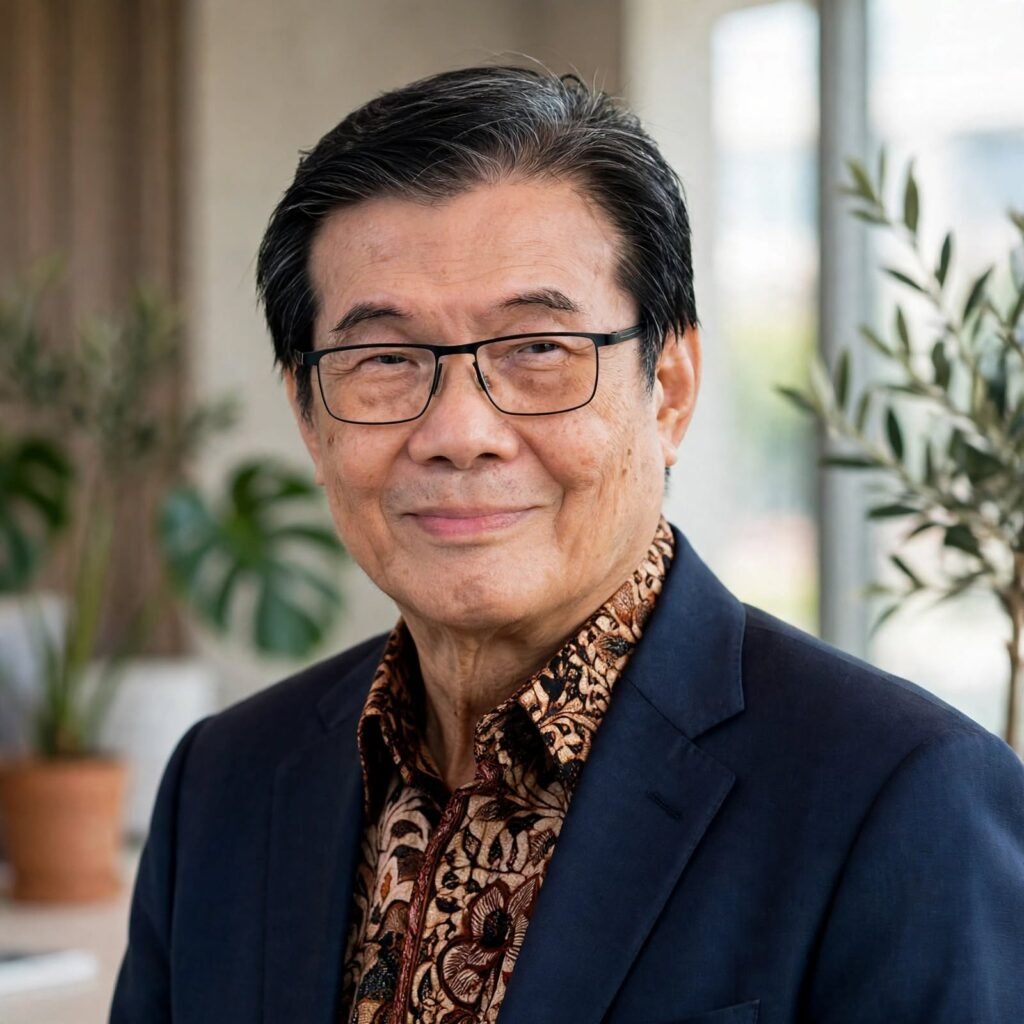
Prajogo Pangestu’s journey to extraordinary wealth did not begin in a modern office, a wealthy family business, or a world of powerful investors. It began in a poor household in West Kalimantan, Indonesia, where even getting an education was a challenge. Before becoming one of Indonesia’s richest businessmen, he worked as a clothing maker, collected rubber, drove a public transport vehicle, and spent years learning the business world from the ground up.
Today, his name is closely associated with Barito Pacific, one of Indonesia’s major industrial groups, with interests in petrochemicals, energy, forestry, mining, and renewable power. His fortune has experienced extraordinary increases, particularly after his companies entered the geothermal energy market and attracted strong interest from investors.
But the most interesting part of Pangestu’s story is not simply how much money he made. It is how a man who started with very limited resources managed to move from one industry to another, recognise opportunities, survive difficult economic conditions, and build businesses that eventually became major players in Indonesia’s economy.
His journey offers an important lesson about wealth creation: sometimes, the biggest opportunities come when a person is willing to move beyond the business that first made them successful.
A Childhood Where Survival Came Before Ambition
Prajogo Pangestu was born as Phang Djoen Phen on May 13, 1944, in Bengkayang, West Kalimantan, Indonesia. He came from a Hakka family with modest financial circumstances. His father was involved in the rubber trade, and the family struggled to meet basic needs.
Education was not an easy path for him. He reportedly began elementary school at around nine years old and later had to leave school because of financial difficulties. Some accounts describe him working to support himself and his family, including making clothes and collecting rubber.
These early experiences placed him in a very different position from many future business leaders who begin their careers with university degrees, financial support, and established professional networks.
Pangestu had limited formal education, but he gained something else through experience. He became familiar with buying, selling, transportation, customers, and the movement of goods.
His father’s involvement in the rubber trade also meant that business was not completely unfamiliar to him. He grew up close to the practical realities of commerce, where making money depended on understanding products, prices, suppliers, and demand.
This background would become important later. His career was not built around one academic qualification or a specialised professional skill. It developed through practical work and years of exposure to different businesses.
Leaving Home in Search of a Better Future
In 1965, Pangestu moved to Jakarta with hopes of improving his financial situation. Like many people who leave their hometowns in search of opportunity, he was looking for a chance to build a better life.
However, his first attempt did not produce the success he had hoped for. His efforts in Jakarta failed, and he eventually returned to Kalimantan.
For someone with limited money and few professional connections, this could have been a discouraging experience. But returning home did not mean that his working life had ended.
He began driving a public transportation vehicle, commonly known as an angkot. It was a modest occupation, far removed from the industrial empire he would eventually control.
Yet this period introduced him to people from different backgrounds and helped him develop useful business relationships.
One of the most important connections of his early career was Burhan Uray, a Malaysian businessman involved in the timber industry. Uray recognised Pangestu’s determination and gave him an opportunity to enter the timber business.
This meeting became a turning point.
It demonstrates an important feature of successful business careers: opportunities do not always arrive in the form of money or an investment. Sometimes, an opportunity comes through a person who recognises someone’s ability and gives them a chance to prove themselves.
Seven Years of Learning Before Building His Own Business
Around 1970, Pangestu joined the Djajanti Group, a timber business owned by Burhan Uray. He entered an industry that would become the foundation of his future wealth.
He did not immediately establish his own company or become a major businessman. Instead, he spent years learning how the timber industry operated.
He gained experience in the business and eventually became a general manager at PT Nusantara within the group.
This period was important because it gave him practical exposure to an industry much larger and more complicated than the small-scale trading activities he had previously experienced.
Timber was not simply a product that could be bought and sold. It involved sourcing, processing, transportation, commercial relationships, operations, and market demand.
Understanding these elements helped prepare him for the responsibilities of running his own company.
By 1977, Pangestu decided to leave the group and establish his own business.
The decision was significant. He was moving away from a position within another person’s organisation and accepting responsibility for his own commercial future.
Instead of remaining satisfied with a managerial position, he wanted to build something that he could control and develop.
This was the beginning of the business journey that eventually produced Barito Pacific.
Turning a Struggling Company into a Business Opportunity
One of Pangestu’s important early business moves involved acquiring CV Pacific Lumber Coy, a timber company experiencing financial difficulties.
For many investors, a struggling company represents a problem. It may have financial obligations, operational weaknesses, and an uncertain future.
But Pangestu saw an opportunity to take control of an existing business and improve its position.
Under his leadership, the company recovered from its financial difficulties and developed into a larger enterprise. It eventually became known as PT Barito Pacific Timber.
This decision reveals an important aspect of his business development: he was willing to work with existing businesses rather than always starting from nothing.
An established company may already have employees, customers, suppliers, equipment, and commercial relationships. If its problems can be managed, those existing resources can provide a foundation for future growth.
The challenge is knowing which problems can be solved and whether the business has enough potential to justify the effort.
Pangestu’s early experience in the timber industry gave him an advantage when making such decisions. He understood the sector and could see how a struggling company might become valuable under different management.
His success in this period helped establish his reputation as an entrepreneur capable of turning business opportunities into larger enterprises.
The Decision That Changed the Scale of His Wealth
Building a timber business was an important achievement, but Pangestu did not want his future to depend entirely on one industry.
Timber had created his first major business foundation. However, depending on a single sector also meant being exposed to its economic conditions, regulations, resource limitations, and market changes.
He began looking beyond the industry that had made him successful.
In 1993, Barito Pacific Timber became a publicly listed company on the Jakarta Stock Exchange. This was a major milestone because it gave the business access to the public capital market.
A stock market listing can change the possibilities available to a company. Instead of depending entirely on its original owners and internal financing, a listed business can attract outside investors and use capital raised through the market to support expansion.
For Pangestu, the listing represented more than a financial achievement. It provided a platform from which he could develop a much larger business group.
He could now pursue opportunities in industries that required greater investment and more complex operations.
His company was no longer simply a timber business. It was gradually becoming an industrial conglomerate.
This is one of the most important lessons from his career: the ability to build a successful business is valuable, but knowing how to use that success as a foundation for something bigger can create an entirely different level of wealth.
Moving Beyond Timber: The Shift into Petrochemicals
One of Pangestu’s most important strategic decisions was expanding into petrochemicals.
Petrochemicals are used to produce materials that support countless modern industries. Plastics, packaging, automotive components, electronics, and many everyday products depend on petrochemical materials.
The sector offered opportunities on a much larger industrial scale than traditional timber trading.
Through his involvement in Chandra Asri, Pangestu developed a major position in Indonesia’s petrochemical industry. His business interests eventually came to include Chandra Asri Petrochemical, which became one of the country’s leading producers.
This move was not simply about adding another business to his portfolio. It represented a shift towards industries with substantial manufacturing capacity and wider commercial applications.
His companies could now participate in supply chains that extended beyond Indonesia.
Petrochemicals also provided a different source of business activity from forestry. Rather than depending primarily on timber resources, the company was involved in producing industrial materials needed by multiple sectors.
Over time, Barito Pacific became associated with petrochemicals, energy, plantations, property, and other industrial activities.
In 2007, the company dropped the word “Timber” from its name and became PT Barito Pacific Tbk.
The name change reflected a business that had moved far beyond its original identity.
Pangestu had built his first fortune in timber, but he was no longer thinking like a timber trader.
Patience Through Economic Uncertainty
Building a large industrial group requires more than identifying profitable opportunities. It also requires surviving periods when markets move in the wrong direction.
Pangestu’s business career developed through several periods of economic uncertainty, including the Asian Financial Crisis of 1997–1998.
During such crises, companies can face declining demand, financial pressure, currency instability, and difficulties meeting their obligations.
Businesses that appear successful during good economic conditions can suddenly become vulnerable.
Pangestu’s broader strategy of restructuring and expanding into different sectors helped his business group navigate difficult periods. One account of his career describes aggressive debt restructuring and the acquisition of shares from competitors as part of his approach to strengthening the group.
The important point is that he did not build his fortune through uninterrupted growth.
His businesses operated in industries where prices, regulations, investment conditions, and economic cycles could change considerably.
He also had to deal with the challenges of moving from forestry into more capital-intensive industrial operations.
Such changes require time, financing, and the ability to manage businesses that operate very differently from one another.
His journey suggests that patience in business is not simply waiting for better days. It also means making practical changes when the existing business model faces difficulties.
Sometimes survival requires restructuring. At other times, it requires entering a new industry or reducing dependence on an older one.
Seeing the Future in Geothermal Energy
One of the most important chapters in Pangestu’s rise to extraordinary wealth came through renewable energy.
While many businessmen remained focused on traditional energy sources, Pangestu developed a significant interest in geothermal power.
Geothermal energy uses heat from beneath the Earth’s surface to generate electricity. Unlike energy sources that depend on changing weather conditions, geothermal power can provide a relatively continuous supply of electricity when properly developed and operated.
Indonesia has considerable geothermal resources because of its geographical position along the Pacific Ring of Fire.
This gave Pangestu an opportunity to invest in an industry with strong domestic potential and growing international importance.
In March 2022, his Singapore-based company Green Era acquired a 33.33% stake in Star Energy from Thailand’s BCPG for approximately $440 million. This transaction helped bring Star Energy under his business group’s control.
Star Energy became a central part of his renewable energy strategy.
Through its geothermal operations, the company developed a major position in Indonesia’s electricity market.
By 2023, Star Energy Geothermal had an installed generation capacity of approximately 886 megawatts, operating three geothermal power projects in West Java.
This investment demonstrated a different kind of business thinking.
Pangestu was not simply expanding into another industry because it was profitable at that moment. Geothermal energy offered the possibility of participating in a sector that could become increasingly important as countries looked for alternatives to more carbon-intensive energy sources.
It also provided an opportunity to build a business around Indonesia’s natural resources.
The timing of this move became particularly important.
The 2023 Wealth Explosion
In 2023, Pangestu’s geothermal investments received extraordinary attention from the financial markets.
His company, Barito Renewables Energy, was listed on the Indonesian stock exchange in October 2023.
Investor demand for its shares was exceptionally strong. The share price rose approximately fivefold after listing, while the company’s market value increased from around $8.3 billion to approximately $45 billion.
The rapid increase created a dramatic effect on Pangestu’s personal fortune.
His net worth rose above $40 billion, according to Forbes’ Real-Time Billionaires List in November 2023.
Earlier that year, Forbes had estimated his wealth at approximately $5.3 billion.
Within a relatively short period, the rise in the value of his business holdings transformed his position among Indonesia’s wealthiest people.
He surpassed Low Tuck Kwong and became Indonesia’s richest person.
But there is an important distinction to understand about this wealth increase.
It did not mean that Pangestu suddenly received tens of billions of dollars in cash. Much of the increase came from the rising market value of companies in which he held large ownership interests.
His wealth was closely connected to the value investors placed on his businesses.
This distinction matters because stock market wealth can increase rapidly, but it can also fall rapidly.
Understanding the Power of Long-Term Investment
Pangestu’s geothermal investment provides an interesting example of how a business decision can take years to produce its greatest financial impact.
The acquisition of Star Energy was not the same as purchasing a simple financial asset and waiting for its price to increase.
Geothermal power requires substantial infrastructure, technical expertise, exploration, equipment, and long-term development.
These projects cannot be built overnight.
The business must develop generating capacity, maintain facilities, manage operating costs, and sell electricity under suitable commercial arrangements.
In 2024, Star Energy announced a $346 million investment to increase the capacity of several geothermal power plant units.
This demonstrates the long-term nature of the business. The company was continuing to invest in expanding its operations rather than relying only on the stock market’s enthusiasm.
Pangestu’s involvement in this sector shows why looking beyond immediate profits can be important.
A business opportunity may require years of investment before its full commercial potential becomes visible.
However, long-term investment does not guarantee success. It requires careful management, sufficient capital, technical capability, and favourable market conditions.
The geothermal industry offered Pangestu an opportunity to build on Indonesia’s natural resources while participating in the global transition towards cleaner energy.
His Wealth Also Experienced Major Losses
Although Pangestu’s fortune rose dramatically, his business journey has also demonstrated the risks of relying heavily on stock market valuations.
In 2024, the prices of several companies associated with his business group experienced sharp declines.
One report described a loss of approximately $5.4 billion in February 2024, followed by another decline of around $5.9 billion in September.
Changes in market indexes also affected investor confidence. When FTSE Russell announced that Barito Renewables would be removed from its indexes, the company’s shares fell significantly.
The resulting decline erased nearly $12 billion from Pangestu’s peak net worth, according to the same report.
These figures reveal something important about the nature of billionaire wealth.
A person can spend decades building companies, factories, infrastructure, and commercial relationships, yet the market value of their shares can change dramatically within days.
This does not necessarily mean that the underlying business has lost the same amount of productive capacity or cash.
It means that market expectations, investor confidence, trading activity, and company valuations can have a powerful influence on paper wealth.
Pangestu’s experience is a reminder that business success and stock market performance are related, but they are not the same thing.
The Psychology Behind His Business Decisions
Pangestu is known as a relatively private businessman. He does not regularly seek public attention in the way some internationally recognised entrepreneurs do.
As a result, there is limited reliable information about his personal routines, daily working habits, or private thinking.
However, his business decisions offer several clues about the approach that helped him build his fortune.
First, he was willing to change industries.
He began in timber, expanded into petrochemicals, and later developed major interests in energy and mining.
Many business owners become too attached to the industry that first made them successful. They continue following the same business model even when the market begins changing.
Pangestu’s career demonstrates the value of recognising that an earlier success does not have to determine the direction of the next stage.
Second, he understood the importance of controlling valuable businesses.
Rather than limiting himself to small investments, he pursued significant ownership interests in companies that could become central to his business group.
The acquisition of financially troubled Pacific Lumber and the expansion of his position in major industrial businesses illustrate this approach.
Third, he used business opportunities to build on existing strengths.
His move into petrochemicals was supported by the industrial experience and financial platform he had developed through Barito Pacific.
His geothermal investments also expanded the group’s existing energy interests.
These were not completely disconnected activities. They became parts of a broader industrial strategy.
Finally, he demonstrated a willingness to invest for the future.
His geothermal investments required considerable capital and long-term development.
The eventual rise in Barito Renewables’ market value demonstrated the potential financial rewards of entering an industry before its full market value was widely recognised.
The Importance of Relationships and Business Networks
Pangestu’s career also highlights the role of relationships in building a large business.
His early opportunity came through Burhan Uray, who gave him access to the timber industry.
Later, his companies developed relationships with international businesses and investors.
His ability to operate within Indonesia’s commercial and regulatory environment also played a role in the development of his business group.
During the Suharto era, his timber interests benefited from government policies and concessions that supported the forestry industry. This aspect of his business history is important because the development of large Indonesian timber businesses also raises questions about forest management, environmental damage, and the relationship between business and political power.
His success should therefore not be presented as the result of personal determination alone.
Access to commercial opportunities, industry conditions, government policies, and relationships also influenced the environment in which his businesses grew.
For aspiring entrepreneurs, the lesson is that relationships matter, but they should be combined with the ability to deliver results and manage a business effectively.
Building a Business Group That Could Outlive One Industry
One of Pangestu’s most important achievements was transforming Barito Pacific from a timber-focused company into a diversified industrial group.
This transformation required a different way of thinking about business growth.
Instead of depending on one product or one market, the group developed interests in several industries.
Its major areas of business came to include:
- Timber and forestry: The original foundation of his business career.
- Petrochemicals: Through major interests in Chandra Asri.
- Renewable energy: Particularly geothermal power through Star Energy and Barito Renewables.
- Coal and mining: Including the development of Petrindo Jaya Kreasi.
- Plantations and property: Additional sectors that formed part of the group’s wider business interests.
Diversification can reduce dependence on one industry, although it does not automatically eliminate risk.
Different businesses require different skills, investment decisions, management systems, and financial resources.
The real challenge is managing several industries without losing control of the overall organisation.
Pangestu’s career demonstrates the importance of building a business structure that can develop beyond its original product.
Family, Privacy, and the Next Generation
Despite his enormous fortune, Pangestu has generally maintained a relatively private public profile.
His family has also been involved in parts of the business group. His son Agus Salim Pangestu has held leadership responsibilities within Barito Pacific, while his daughter Nancy Pangestu has been associated with Green Era.
This involvement suggests that family participation is an important part of the group’s long-term structure.
However, the detailed succession arrangements and future distribution of responsibilities should not be assumed without clear confirmation.
Building a successful company is one challenge. Preparing it for the next generation is another.
A business empire may have valuable assets, strong market positions, and an established reputation, but it still needs capable leadership to continue operating successfully.
Pangestu’s family involvement reflects the importance of continuity in a large business group.
What Ordinary People Can Learn from His Journey
Prajogo Pangestu’s success cannot be copied simply by entering the timber, petrochemical, or geothermal industries. His businesses developed under particular economic, political, and geographical conditions.
Nevertheless, several lessons from his career are useful for people who want to build their own businesses.
- Your Starting Point Does Not Have to Define Your Future
Pangestu came from a financially struggling family and did not receive extensive formal education.
His early circumstances limited his choices, but they did not prevent him from gaining practical experience and moving into larger opportunities.
A difficult beginning does not guarantee success, but it does not have to determine the limits of someone’s ambition either. - Learn Before You Become an Owner
He spent years working in the timber industry before starting his own business.
That experience helped him understand how the industry operated.
For a young entrepreneur, learning the practical details of a business can be more valuable than rushing into ownership without understanding the market. - Do Not Become Trapped by Your First Success
Timber created Pangestu’s initial business foundation, but he eventually moved into petrochemicals and energy.
The lesson is to keep evaluating whether your current business still offers the best opportunities.
Being successful in one area should not stop you from learning about another. - Look for Value Where Others See Problems
His acquisition of a financially troubled timber company demonstrates how an existing business can sometimes offer an opportunity for improvement.
However, buying a struggling business is only sensible when its problems can realistically be solved.
Understanding the reasons behind a company’s difficulties is essential before making such a decision. - Think Beyond Immediate Profit
Geothermal energy requires significant investment and long development periods.
Pangestu’s involvement in the sector shows the potential value of businesses that are built around long-term demand.
Entrepreneurs should consider not only what customers want today, but also which needs may become more important in the future. - Understand the Power of Capital
Barito Pacific’s public listing in 1993 helped create opportunities for expansion.
Businesses often reach a stage where their own resources are no longer sufficient for further growth.
Learning how to raise and manage capital can help turn a small enterprise into a much larger organisation. - Be Prepared for Difficult Periods
Economic crises, changing market conditions, and falling share prices affected Pangestu’s businesses and personal fortune.
His journey demonstrates that successful business ownership requires the ability to respond when conditions become difficult.
Growth is rarely a straight line. - Build Relationships That Create Real Opportunities
His introduction to Burhan Uray changed the direction of his career.
Professional relationships can provide knowledge, opportunities, partnerships, and access to markets.
But maintaining those relationships requires trust, reliability, and the ability to contribute something valuable.
The Real Secret Behind Prajogo Pangestu’s Success
Prajogo Pangestu did not become a billionaire through one lucky investment or one successful company.
His wealth developed through a series of business decisions made across several decades.
He started with limited resources, gained practical experience in timber, established his own business, acquired and improved an existing company, and eventually transformed Barito Pacific into a diversified industrial group.
His move into petrochemicals gave him access to a larger industrial market. His investments in geothermal energy opened the door to one of the most important financial developments of his career.
What makes his journey particularly interesting is the ability to move beyond an earlier success without abandoning the experience and business foundation that made it possible.
He understood that an entrepreneur must continue learning, adapting, and recognising new opportunities.
His story also carries an important reminder: extraordinary wealth is not built through determination alone. Business ownership, access to capital, market conditions, relationships, government policies, and timing all influence the final result.
The most meaningful lesson is not that everyone should try to become a billionaire. It is that people should learn how to recognise opportunities, develop useful skills, understand their industries, and make decisions with a longer-term perspective.
Prajogo Pangestu started his working life far from the world of billion-dollar companies. He spent years learning, working, and building relationships before creating a business of his own.
His fortune rose and fell with the value of the companies he developed, but the foundation of his business career was built over decades.
Perhaps the greatest lesson from his journey is this: do not become so comfortable with the business that made you successful that you stop looking for the next opportunity. Build something valuable, understand why it works, and have the courage to evolve when the future begins to change.