
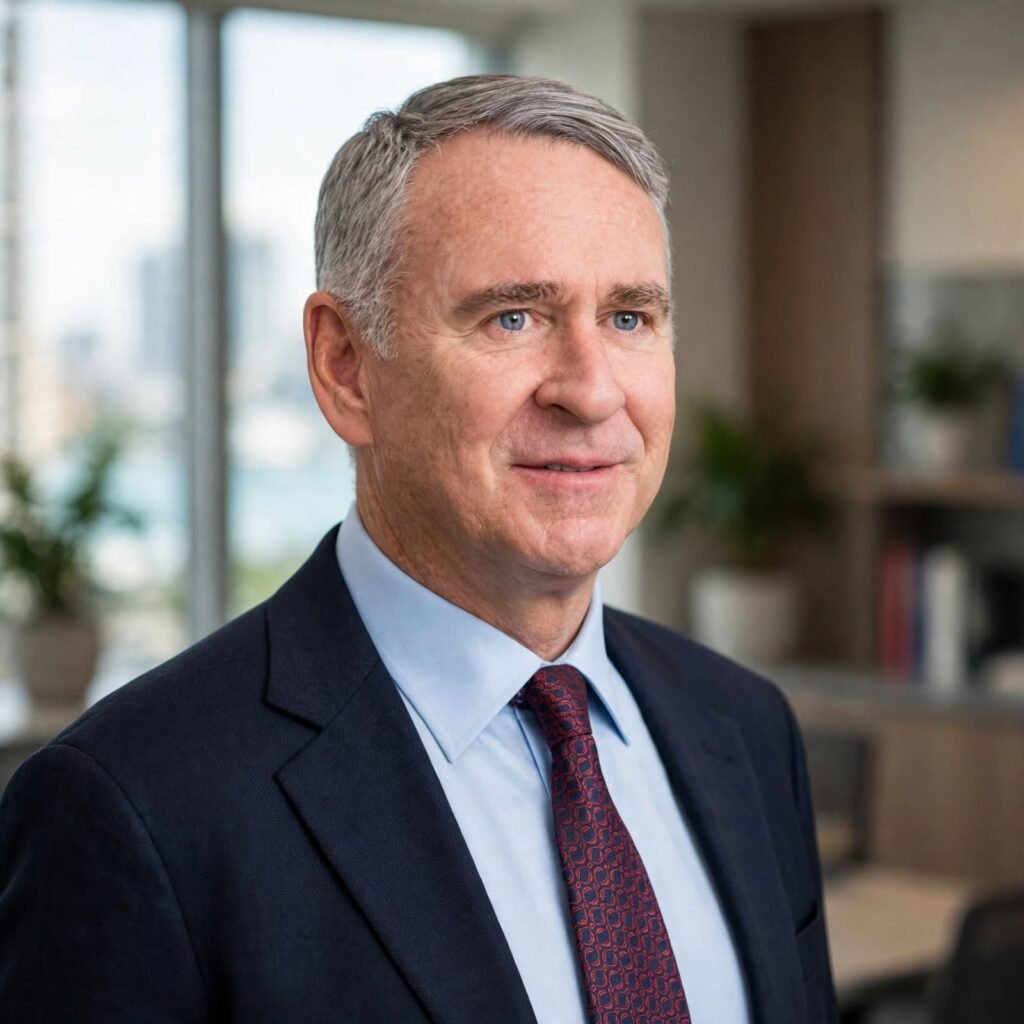
At just 19 years old, Ken Griffin was already thinking about money differently from most people his age. While other university students were focused on their studies and social lives, he was studying financial markets, writing computer programs and trading securities from his Harvard dormitory.
He did not begin with a large investment company, a powerful financial network or millions of dollars in personal wealth. He began with a computer, a telephone, borrowed confidence from a few early investors and a strong interest in understanding how markets worked.
Nearly four decades later, Griffin had built two major financial businesses: Citadel, one of the most successful hedge funds in history, and Citadel Securities, a powerful market-making firm. His wealth reached tens of billions of dollars, making him one of the richest people in the world.
But the most interesting part of his story is not simply how much money he made. It is how he approached business. Griffin did not depend on one investment idea or a single successful strategy. He built an organisation that constantly searched for new opportunities, studied its competitors and changed its methods whenever an advantage began to disappear.
His journey offers a closer look at how curiosity, technology, calculated risk-taking and relentless improvement can turn a small beginning into a financial empire.
Early Life: A Curious Mind With an Interest in Business
Kenneth Griffin was born in Daytona Beach, Florida, in 1968. His father worked in the space programme at General Electric before later becoming a chief financial officer at a roofing company. His family moved several times during his childhood, eventually settling in Boca Raton, Florida.
Griffin showed an interest in technology and business while he was still at school. After persuading his parents to buy him an IBM personal computer, he began learning how to write computer code. He also took part in mathematics-related activities and community service.
But he was not interested in technology only as an academic subject. He was already looking for ways to turn his knowledge into money. He sold software to students and teachers, gaining early experience in finding customers and recognising business opportunities.
This combination of interests would later become important. Griffin understood that computers could do more than make everyday tasks easier. They could help people analyse information, identify patterns and make decisions faster.
In 1986, he entered Harvard University, where he studied economics and government. He was particularly interested in financial markets and corporate takeovers. Rather than treating university as simply a path towards getting a job, he was already thinking about building something of his own.
That ambition became clear when he started trading from his dormitory.
The Harvard Dormitory: Where the Journey Took Shape
Griffin began investing while studying at Harvard. His early trading focused on convertible securities, a type of financial instrument that combines features of bonds and shares.
He became interested in convertible arbitrage, a strategy involving the purchase of convertible bonds while taking a short position in the underlying company’s stock. The aim is to identify pricing differences and manage the risks between the two positions.
The strategy required careful calculations and access to reliable market information. At that time, getting real-time financial data was not as easy as it is today.
Griffin found a practical solution. He arranged to install a satellite dish on the roof of his Harvard dormitory so that his computer could receive market information. His small operation gradually became more sophisticated, allowing him to analyse securities and make trading decisions from his room.
He raised approximately $265,000 from early investors, including his mother, grandmother and two other people. Other accounts describe him raising more than a million dollars as the operation developed. The important point is that his first fund was built with outside backing rather than a large personal fortune.
One of the earliest opportunities came during the period of market volatility surrounding the 1987 stock-market crash. Griffin was already trading and managing money at a very young age. However, the real achievement was not simply being involved in one market event. It was developing the technical knowledge and investment methods that would support his later career.
His work attracted the attention of Frank Meyer, a hedge fund manager associated with Glenwood Capital. Meyer backed Griffin and gave him an opportunity to manage capital on a larger scale.
Griffin reportedly generated a 70 per cent return in a single year while working with Meyer. That performance helped attract further interest from investors.
He graduated from Harvard with honours in economics in 1989, completing his degree in three years. Instead of pursuing a conventional career in finance, he continued building the business he had started as a student.
Building Citadel: Turning a Small Fund Into a Serious Business
On November 1, 1990, Griffin founded Citadel in Chicago with approximately $4.6 million in seed capital.
At that point, he was still a young entrepreneur competing in an industry filled with experienced financial professionals. He did not have the reputation or resources of the biggest Wall Street institutions.
What he had was a clear idea: a successful investment firm needed more than talented traders. It needed technology, research, information and a structure that could keep producing good results.
An important early influence was Frank Meyer, who encouraged Griffin to adopt multiple investment strategies rather than depending on one approach. Meyer also supported a fee structure that allowed Citadel to pass certain operating expenses through to investors.
This gave the young firm more room to spend on technology, infrastructure and skilled employees. Such spending could be expensive, but Griffin believed that the right resources could create an advantage over competitors.
The early Citadel was not a traditional financial office. It had a strong technical atmosphere, and information technology employees made up a significant part of its workforce. Griffin even developed trading models for employees to use on the firm’s computer systems.
He understood that a trading opportunity could disappear quickly once competitors discovered it. The company therefore needed to process information, test ideas and execute decisions efficiently.
This approach became one of the foundations of Citadel’s long-term growth.
His Real Advantage: Constantly Looking for a Better Way
Griffin’s success was not built around one famous investment philosophy. He was not simply a long-term stock investor, nor was he known for making occasional enormous bets based on personal predictions.
His approach was different. He wanted to build a financial business that could identify opportunities across many markets and continuously improve the systems used to capture them.
Citadel expanded beyond convertible bonds into equities, fixed income, commodities, credit, foreign exchange and quantitative trading.
This diversification allowed the firm to find opportunities in different market conditions. When one strategy became less attractive, other areas could potentially contribute to performance.
Griffin also paid close attention to what competitors were doing. When he learned that another firm was making money through statistical arbitrage, for example, he wanted Citadel to understand the method and explore whether it could develop its own version.
He did not need to invent every successful idea himself. He needed to recognise useful ideas early, bring the right people together and improve them.
This is an important distinction.
Many businesses become successful because they introduce something completely new. Others succeed by taking an existing idea and executing it better than their competitors. Griffin built his career largely around the second approach.
He once explained that Citadel’s distinctive qualities were not necessarily a thousand completely unique ideas. The advantage came from combining many improvements across the organisation.
That meant technology, research, trading methods, risk management and employee performance all mattered.
For Griffin, success was not a permanent achievement. It was something the company had to earn repeatedly.
The Power of Technology and Better Information
Technology was central to Griffin’s business from the beginning.
As a student, he used computer programming to calculate the value of financial securities. As Citadel expanded, it invested heavily in software, computing infrastructure, data analysis and trading systems.
The purpose was not simply to make the company look modern. Technology helped the firm identify pricing differences, evaluate risks and execute transactions more efficiently.
One important example was Citadel’s decision to develop its own trade-clearing capabilities rather than relying entirely on outside financial institutions to settle transactions.
By handling more of this process internally, the firm gained greater control over its operations and could understand its financial position more quickly.
This became especially valuable during periods of market stress, when knowing exactly where money and risk stood could make a significant difference.
Griffin also understood that technology was not limited to computers. Better information could come from almost anywhere.
As Citadel expanded its commodities business, it recruited specialists with knowledge of weather, energy markets and physical conditions. These experts helped the firm turn information from weather stations, satellites and other sources into better forecasts for commodities trading.
This strategy became particularly successful in European natural gas markets during 2022 and 2023, when prices surged following Russia’s invasion of Ukraine. Citadel’s commodities business reportedly generated more than $10 billion over those two years.
The lesson is that valuable information is not always found in the same place as everyone else is looking. Sometimes the advantage comes from connecting knowledge from different industries.
The Pod Structure: Making Talent Accountable
One of Citadel’s most influential business models became known as the pod structure.
Instead of allowing one large investment team to control an entire portfolio, the company divided its trading operations into smaller groups. Each group focused on particular investments and markets.
A portfolio manager might lead a team of analysts and associates responsible for researching specific companies or industries. Their performance was monitored closely.
Teams that performed well could receive more capital. Teams that consistently failed to deliver could lose their funding or eventually be closed.
This structure allowed Citadel to operate many investment strategies at the same time without depending entirely on one person’s decisions.
It also created strong accountability. Employees had responsibility for their own results, and the company could compare performance across different teams.
The model was effective, but it also created a demanding working environment. Citadel became known for high expectations, intense competition and frequent employee turnover.
Griffin believed that a high-performance organisation could not become comfortable with average results. His approach was to reward strong performance while making it clear that poor performance had consequences.
This culture helped the firm attract ambitious financial and technical professionals, although it also came with personal costs for employees who struggled with its demands.
Failure and the 1994 Setback: Success Was Never Guaranteed
Citadel’s early progress did not mean that every year was profitable.
In 1994, the bond market suffered a major downturn, and Citadel recorded its first losing year, falling approximately 4.3 per cent.
The firm responded by reviewing its performance and making changes to its trading teams. Some recently hired traders were dismissed.
For a young company, a difficult year could have damaged investor confidence and slowed its development. But Griffin continued expanding the business and searching for new strategies.
A few years later, Citadel adopted another important approach: protecting its capital structure during periods of market uncertainty.
Griffin arranged for investors’ money to be locked up under certain conditions, rather than allowing everyone to withdraw immediately whenever markets became unstable.
This decision was not necessarily attractive to investors who wanted immediate access to their money. But it gave Citadel greater control over its capital during difficult periods.
In 1998, the firm benefited from market disruption by purchasing assets when other financial businesses were struggling with funding and investor withdrawals.
Citadel reached approximately $1 billion in assets under management that year. By 2004, the figure had grown to around $10 billion.
The lesson was not that financial trouble automatically creates opportunities. It was that a company needs enough preparation, capital and confidence to act when other market participants are forced to retreat.
The Biggest Test: Losing 55 Per Cent During the 2008 Financial Crisis
The greatest test of Griffin’s career came during the global financial crisis of 2008.
Citadel’s main funds lost approximately 55 per cent of their value. The crisis exposed weaknesses in the firm’s assumptions about how different investments would behave under extreme conditions.
Citadel had built its strategies around diversification and the belief that many of its positions would not move in the same direction at the same time.
But when financial markets entered a severe crisis, relationships between different investments changed. Positions that had appeared relatively independent began suffering losses together.
Griffin later described the experience as losing virtually everything in sixteen weeks.
The firm also faced serious pressure from investors. It restricted withdrawals as markets deteriorated, a decision that created anger and damaged confidence.
Some competitors and commentators believed Citadel might not survive. Financial markets were under enormous pressure, and even large institutions were struggling.
Griffin and several partners put approximately $500 million of their own money into the fund, partly to support the business and retain employees who had not lost money.
The recovery was not immediate. Citadel had to rebuild investor confidence and overcome the previous performance high-water mark before it could again receive performance fees on new gains.
Griffin also chose not to close the fund and start again under a new structure, which would have allowed the business to avoid the burden of previous losses. Instead, the firm continued operating and working towards recovery.
By 2012, Citadel had regained its previous high-water mark.
The crisis changed how Griffin thought about risk. It demonstrated that diversification alone could not protect a business from every unexpected event. A strategy that appears safe under normal conditions can behave very differently during a crisis.
The experience strengthened the importance of liquidity, central risk oversight and understanding how different positions might react under extreme circumstances.
Perhaps the most important lesson from 2008 was that a successful business must prepare for situations that its existing models do not fully anticipate.
Building a Second Empire: Citadel Securities
While Citadel was growing as an investment manager, Griffin was developing another major business.
Citadel Securities became a separate company in 2012, although its origins came from trading and market-making activities developed within the wider Citadel organisation.
The difference between the two businesses is important.
Citadel manages investment capital and seeks to generate returns for its investors. Citadel Securities operates as a market maker, providing prices at which financial assets can be bought and sold.
When an investor places an order, a market maker can help match buyers and sellers, providing liquidity and making transactions easier to complete.
The business earns money through the enormous volume of transactions it handles and the small differences between buying and selling prices.
Griffin recognised that electronic trading was changing the financial industry. Speed, computing power and efficient execution were becoming increasingly important.
Citadel Securities invested heavily in technology and communication infrastructure. One major competitive advantage came from using faster fibre-optic connections between important financial centres, including Chicago and New Jersey.
These improvements allowed the company to respond more quickly to changing prices across different exchanges.
Over time, Citadel Securities became one of the most powerful market-making firms in the United States. Company figures cited in 2026 indicated that it handled more than 23 per cent of U.S. equity-market volume and around 30 per cent of U.S. equity-options volume.
In 2025, the firm reportedly generated $12.2 billion in revenue and $5.4 billion in net income.
This second business became a major part of Griffin’s personal fortune. It also reduced the extent to which his wealth depended on the performance of the hedge fund alone.
Building two highly profitable businesses in different areas of finance was one of the most important reasons his fortune grew to such an extraordinary level.
Learning From Competition Instead of Becoming Comfortable
One of Griffin’s most consistent qualities was his attention to competitors.
He understood that a strategy that works today may become less profitable tomorrow. When other firms discover the same opportunity, competition increases and the advantage gradually disappears.
This is known as the decline of an investment edge, often called alpha decay.
Citadel experienced this challenge as it became larger. Between 2015 and 2018, the firm’s average annual gains declined significantly compared with earlier periods.
Griffin responded by changing the business again.
He became more directly involved in the commodities division and invested in new specialists, technology and research. The firm recruited hundreds of employees, including experts in weather and other scientific fields.
This was not simply a decision to spend more money. It was an attempt to find opportunities that other financial firms had not fully understood.
Griffin’s approach reveals something important about his psychology: he did not view past success as proof that the company would remain successful.
Instead, he treated success as a reason to keep improving.
He believed that complacency was one of the greatest dangers to a business. A company can have talented employees, strong financial results and an excellent reputation, yet still fall behind if it stops questioning its own methods.
That thinking helped Citadel continue adapting even after it had become one of the world’s leading hedge funds.
The Mindset Behind His Success
Griffin’s career suggests several qualities that played an important role in his achievements.
- Curiosity about how things work
From his teenage years, Griffin showed an interest in technology, mathematics and financial markets. He did not simply accept the way trading was traditionally done. He wanted to understand how prices were calculated, where inefficiencies existed and how technology could improve the process.
His decision to study convertible arbitrage himself is a good example. He was willing to learn a specialised financial strategy rather than limiting himself to what he already knew. - A willingness to challenge established methods
Griffin was prepared to question industry practices. He invested in technology when many traditional financial businesses were less focused on it, developed internal systems and encouraged employees to explore new strategies.
His success did not come from following every established rule. It came partly from understanding which practices could be improved. - Calculated risk rather than blind confidence
Financial trading always involves uncertainty. Griffin built a business that took risks across different markets, but it also invested heavily in research, risk monitoring and operational systems.
The 2008 crisis demonstrated that even sophisticated risk models can fail. His experience showed the importance of questioning assumptions rather than treating calculations as guarantees. - A long-term commitment to improvement
Citadel was founded in 1990, but Griffin’s work did not end when the firm became successful. He continued changing strategies, hiring specialists and investing in technology.
His career demonstrates that building a business and keeping it competitive are two different challenges. The second can be just as difficult as the first. - Attention to detail
Griffin remained closely interested in the technical details of the businesses he led. He paid attention to trading systems, computer hardware, research methods and employee performance.
He believed that small improvements across many parts of an organisation could create a significant overall advantage.
The Cost of an Extremely Competitive Culture
Griffin’s success story is not without controversy.
Citadel became known for its demanding working environment, frequent employee turnover and intense performance expectations. Former employees have described long hours and pressure to deliver results.
The company has defended its approach as a deliberately high-performance culture. Griffin’s belief was that employees needed to remain ambitious and that the organisation could not allow poor performance to continue unchecked.
Citadel Securities has also faced criticism over aspects of its trading practices. The firm paid a $22.6 million settlement to the Securities and Exchange Commission over issues involving best execution for certain customer orders between 2007 and 2010. Its market-making model, including payment for order flow, has continued to attract public and regulatory debate.
These issues matter because business success should not be confused with perfection.
Griffin built highly profitable companies, but the methods and working culture behind them have not been universally praised. His story includes both impressive achievements and difficult questions about competition, pressure and the role of financial markets.
Understanding that balance makes his journey more useful to study.
How Ken Griffin Built His Wealth
Griffin’s fortune grew primarily through ownership and the financial performance of the companies he founded.
Citadel generated investment returns by managing money across different strategies and markets. Citadel Securities built a separate business around market making and financial transactions.
The value of these businesses increased as they expanded their operations, attracted capital, developed technology and generated profits.
His wealth is therefore different from a traditional salary or a bank account containing cash. Much of it is connected to the estimated value of his ownership in private companies.
The estimates also change depending on the source and valuation date. A Forbes profile placed his real-time net worth at approximately $57.8 billion on November 12, 2026, ranking him 33rd in the world. Earlier estimates were lower: Bloomberg estimated approximately $57.5 billion in September 2026, while Forbes reported $49.8 billion in March of that year.
These differences do not necessarily mean that Griffin received billions of dollars in cash between those dates. Private-company valuations, financial-market movements and changes in ownership estimates can all affect a billionaire’s reported net worth.
His fortune reflects decades of building and expanding businesses rather than one lucky investment.
Patience, Persistence and the Ability to Start Again
Griffin’s journey began in a university dormitory, but it took decades to build the financial empire he has today.
There was no single moment when everything changed permanently. His progress came through a series of decisions: learning a specialised trading strategy, attracting early investors, launching Citadel, expanding into new markets, developing technology and creating Citadel Securities.
There were also periods when the business faced serious difficulties.
The 1994 loss showed that early growth did not guarantee success. The 2008 crisis nearly destroyed the firm. Later declines in investment performance forced Griffin to reconsider how Citadel could maintain its advantage.
What stands out is his willingness to rebuild rather than simply defend the past.
He did not expect the original convertible-bond strategy to support the company forever. He expanded into new areas, developed different teams and invested in businesses that could become important sources of future growth.
This is a more meaningful form of persistence than simply continuing to do the same thing. It means remaining committed to a long-term objective while accepting that the methods may need to change.
Life Beyond Business
As Griffin’s wealth increased, he also became a major philanthropist and public figure.
He has donated billions of dollars to education, healthcare, scientific research, museums and other institutions. His contributions have included major gifts to Harvard, medical institutions and education initiatives.
In 2024, he donated $125 million to Chicago’s Museum of Science and Industry, which was subsequently renamed the Griffin Museum of Science and Industry.
He has also supported hospitals, universities and public institutions in several parts of the United States.
Griffin’s personal interests include art, architecture, history and collecting important historical documents. His purchases have included rare American historical items and valuable works of art.
His decision to move Citadel’s headquarters from Chicago to Miami in 2022 was another major business and personal decision. He cited concerns about Chicago’s business environment, crime and other local issues. The move reflected his willingness to make significant changes when he believed the conditions around his business were no longer suitable.
What Ordinary People and Entrepreneurs Can Learn From Ken Griffin
Griffin’s career took place in the highly specialised world of financial markets. Most people will never manage a hedge fund or build a market-making company. Nevertheless, several principles from his journey can be applied to ordinary businesses and careers.
Learn skills that solve real problems. Griffin combined economics, mathematics and programming because they helped him understand and improve financial decisions. Learning becomes especially valuable when it can be applied to a real problem.
Look beyond the obvious opportunity. He studied financial strategies that were not yet widely used and explored ways to improve existing systems. Entrepreneurs can do the same by finding problems that competitors overlook.
Do not depend on one source of success. Citadel eventually operated across multiple investment strategies, while Citadel Securities became a separate business. Building more than one source of value can make a company less dependent on a single opportunity.
Invest in the systems behind your results. Griffin understood that a business needs more than talented individuals. Technology, information, organisation and risk management all contributed to Citadel’s performance.
Accept that mistakes can reveal weaknesses. The 2008 crisis exposed problems in Citadel’s risk assumptions. Rather than treating past success as proof that its methods were always correct, the firm had to learn from what went wrong.
Keep improving after success. One of the most important lessons from Griffin’s career is that yesterday’s advantage may not work tomorrow. A business must continue learning, adapting and questioning its own decisions.
Understand the cost of your ambitions. Citadel’s demanding culture helped create a highly competitive organisation, but it also placed significant pressure on employees. Success should be measured with an understanding of its wider consequences, not only financial results.
The Real Reason Ken Griffin Became a Billionaire
Ken Griffin did not become a billionaire simply because he was good at trading. His greatest achievement was turning his understanding of financial markets into organisations capable of generating profits on a massive scale.
He began by identifying an opportunity in convertible securities. He used technology to analyse it more effectively, attracted investors, built Citadel and expanded the company into multiple financial markets. When electronic trading created new opportunities, he developed Citadel Securities into another major business.
His career was also shaped by difficult experiences. The losses of 1994, the financial crisis of 2008 and later periods of weaker performance forced him to reconsider his methods and rebuild parts of the organisation.
Perhaps the most important feature of his approach was his refusal to treat success as a permanent condition. He understood that competitors would eventually discover profitable strategies, technology would change and markets would become more difficult. To remain ahead, the business had to keep evolving.
His story is not a simple lesson about working hard or taking risks. It is about combining knowledge with execution, building systems instead of depending on individual victories, and recognising when an old approach needs to be replaced.
A young student once placed a satellite dish on a university roof because he wanted better information for his trades. That small decision became part of the beginning of a much larger business journey.
The satellite dish did not make Ken Griffin a billionaire. His ability to turn information into decisions, decisions into businesses and businesses into institutions was what ultimately built his fortune.