
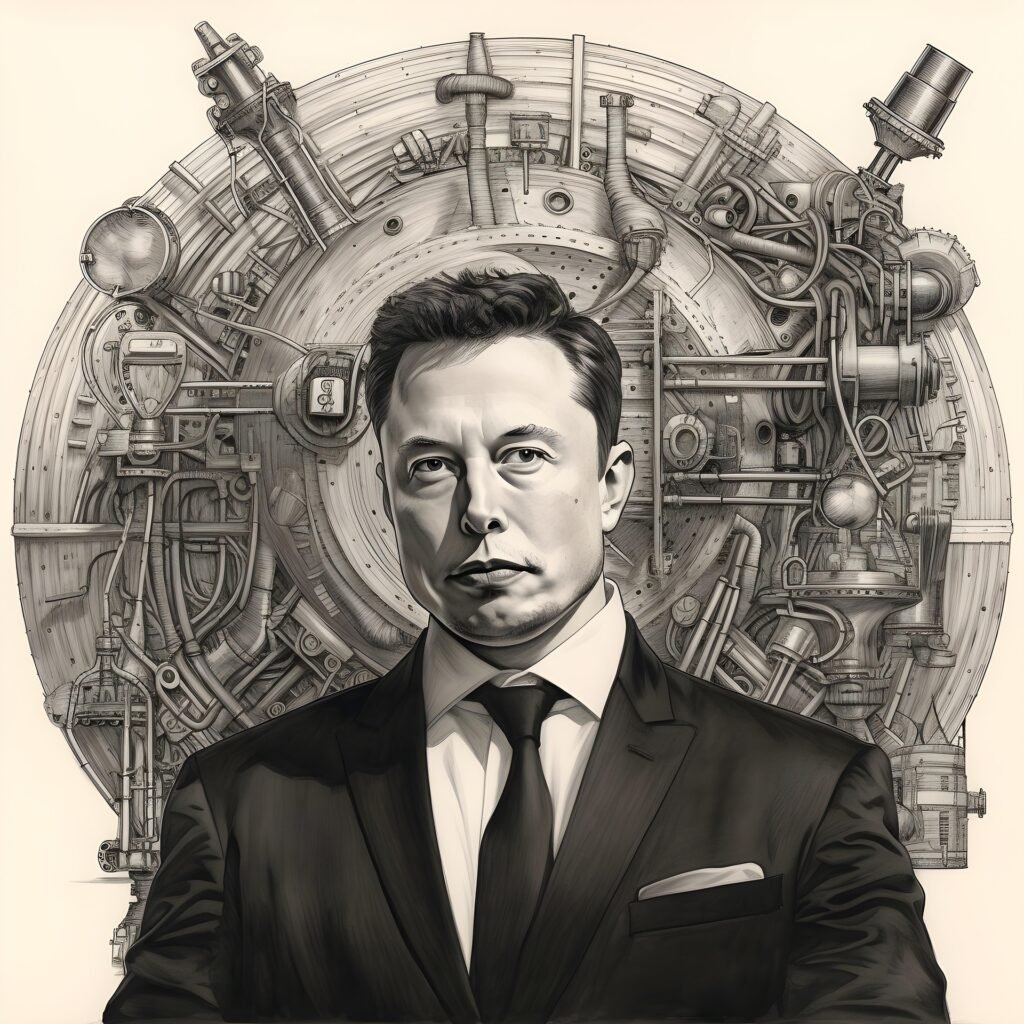
Elon Musk: An Introduction
Elon Musk is a leading businessman in the field of technology. He leads SpaceX, Tesla, and X (formerly Twitter). He is the world’s first trillionaire. In October 2025, he became the first person in the world whose net worth exceeded $500 billion.
Elon Musk is the founder of Tesla and SpaceX and has become a global figure. His extraordinary success, great wealth, and worldwide fame make many people ask: How did he become so rich? What were the key factors behind his success? What strategies and policies helped him build his wealth at such an incredible speed and scale?
Elon Musk did not inherit his wealth. He did not become rich by winning a lottery or any lucky draw. He earned his wealth through hard work. He became wealthy through technological innovation and practical work that matched the needs of the modern technology era.
He is a businessman who is willing to take big risks, and his business activities are based on taking bold risks. One of his main strategies is to keep reinvesting his money. From his birth until today, the journey that made him one of the richest people in the world has been a story of continuous hard work and bold business decisions.
He continues to lead Tesla, SpaceX, and X (formerly Twitter). He also plays an active role in Neuralink and The Boring Company.
A look at his life shows that he earned his first income through computer programming at the age of twelve. He used that early success as the foundation for the rest of his career. After that, his continuous investments and his buying and selling of shares helped increase his wealth. Today, most of his fortune comes from his ownership of Tesla and SpaceX shares.
Elon Musk is known not only for his enormous wealth but also for sharing his views on many subjects through his social media platform. He often speaks about current world affairs, technology, and the future of humanity, which is also one of the reasons for his fame.
Elon Musk’s Early Life
Elon Musk was born in 1971 in Pretoria, South Africa. His family was comfortable, but not very wealthy. His father, Errol Musk, was an electromechanical engineer. He owned some rental properties and, for a time, had a share in an emerald mine. His mother, Maye Musk, was a model and a dietitian.
Although his family could afford computers, books, and a good education, Elon Musk did not inherit great wealth. His family was not extremely wealthy, and the money he later earned did not come from inheritance.
From a young age, Elon Musk was very interested in technology, science, and business. At the age of 10, he received a Commodore VIC-20 computer. He taught himself programming by reading its manual. At the age of 12, he created a simple space video game called Blastar and sold it for $500. This showed that he had strong technical skills and a business mindset, even as a child.
As a child, he was bullied at school and faced some social challenges. Even so, he stayed determined and never gave up.
When he was 17 years old, South Africa was under the apartheid system. To avoid compulsory military service, he moved to Canada using his mother’s Canadian citizenship. There, he worked different temporary jobs before enrolling at Queen’s University. Later, he transferred to the University of Pennsylvania, where he earned degrees in Physics and Economics.
While studying at university, he paid for his education through scholarships, internships, student loans, and other creative ways to earn money. He also organized large house parties to earn extra income.
Although he was accepted into a PhD program in Materials Science at Stanford University, he left after only two days. He wanted to take advantage of the growing internet industry in Silicon Valley.
In 1995, Elon Musk and his brother, Kimbal Musk, founded a company called Zip2. The company created online business directories, maps, and city guides for newspapers. At that time, many traditional newspapers were beginning to use the internet.
In the beginning, the two brothers lived and worked in their small office in Palo Alto. Elon focused on software development, while Kimbal handled sales.
Later, Zip2 grew successfully, and was sold. Elon Musk earned a large amount of money by selling his shares in the company. This money became the financial foundation for his future businesses and helped him start bigger projects.
Elon Musk’s Investment Strategy
Elon Musk is a smart investor. In almost every business he started, we can see careful planning and wise investment.
In 1995, he started Zip2 with his brother, Kimbal Musk. In 1999, Compaq bought Zip2. After the sale, Elon Musk received about $22 million for his share and became a millionaire at the age of 27.
He used this money to start an online banking company called X.com. Later, X.com merged with Confinity, and the new company became PayPal. In 2002, eBay bought PayPal. After the sale, Musk received about $175 million.
Instead of spending this money, he invested it wisely in new and exciting business ideas.
In 2002, Elon Musk started SpaceX. The main goal of SpaceX was to reduce the cost of space travel and help humans live on more than one planet in the future. At first, many rockets failed, and the company faced serious financial problems. But Musk stayed determined and never gave up. In the end, SpaceX won major contracts from NASA and changed the space industry.
In 2004, Musk invested in Tesla Motors. He first became the chairman of the company and later became its CEO in 2008. Under his leadership, Tesla grew very quickly and became the world’s leading electric vehicle company. After 2020, the company grew even faster, and the value of its shares increased greatly.
In 2020, Tesla joined the S&P 500 Index. This increased investors’ confidence in the company, and Musk’s wealth grew rapidly. In that year alone, his net worth increased by more than $140 billion.
Musk also invested in other technology companies, including Neuralink, The Boring Company, xAI, and Twitter, which is now called X. These companies are smaller than Tesla and SpaceX, but they have made his financial position and influence even stronger.
If we look at Elon Musk’s journey to wealth, one thing is very clear. He did not keep his money sitting in the bank. Instead, he kept investing it in new and high-risk businesses. He was not afraid of taking risks. He believed that big risks could create big opportunities. Because of this strategy, his wealth continued to grow over time.
The Growth of Elon Musk’s Fortune
Elon Musk’s wealth increased mainly because of the success of Tesla and SpaceX. After selling Zip2 and PayPal, he used a large part of the money to invest in Tesla and to build SpaceX. This investment later became the foundation of his huge fortune.
In 2008, both Tesla and SpaceX faced a serious financial crisis and were close to bankruptcy. At that critical time, Musk did not give up. Instead, he invested almost all of his remaining personal money into both companies to keep them alive. In the same year, SpaceX received a US$1.6 billion contract from NASA, which helped the company survive and continue growing.
After that, Musk personally shaped the business strategy, future direction, and public image of both companies. Under his leadership, Tesla and SpaceX became two of the world’s most successful companies. For this reason, his leadership is considered one of the main reasons behind their success.
In 2017, Tesla faced a major production crisis while manufacturing the Model 3. During that difficult period, Musk worked day and night to solve the problems. He even slept on the factory floor so that he could closely monitor production and fix issues quickly.
Tesla changed the global electric vehicle industry and made electric cars more popular around the world. On the other hand, SpaceX introduced reusable rockets, which greatly reduced the cost of space launches. This brought a major change to the commercial space industry. SpaceX’s successful space missions, reusable rocket technology, and large contracts with NASA and other government agencies also helped increase Musk’s wealth.
In 2020, Tesla’s share price increased dramatically, and Musk benefited greatly from it. In that year alone, his net worth increased by about US$140 billion. The main reasons were Tesla’s strong stock performance, the company’s inclusion in the S&P 500 Index, growing demand for electric vehicles, important production milestones, and increasing investor confidence.
Since most of Musk’s wealth comes from his ownership of Tesla shares, any major change in Tesla’s share price has a direct effect on his total net worth.
Government support also played an important role in the growth of his companies. NASA contracts, support from the U.S. Department of Defense, regulatory credits, and other government programs helped his businesses expand. However, making the best use of these opportunities was the result of Musk’s leadership and management.
Most of Musk’s wealth comes from owning shares in his companies rather than receiving a salary. He has also invested in projects such as Neuralink, xAI, The Boring Company, OpenAI, X Corp, and Starlink. These investments further increased both his wealth and his influence.
In short, Elon Musk’s fortune is the result of decades of carefully taking risks, continuous innovation, strong leadership, and keeping long-term ownership of his companies, rather than depending on a salary or short-term profits.
Elon Musk: A Journey of Hard Work, Innovation, and Perseverance
Despite a difficult childhood, bullying, and social challenges, Elon Musk never gave up. His curiosity, determination, and love of learning became the foundation of his success. “Perseverance is the power that turns failure into success.”
From his early ventures, Zip2 and PayPal, to Tesla and SpaceX, Musk’s journey proves that great achievements begin with great dreams. “Those who dream big are the ones who dare to take big risks, and big risks often lead to great success.”
Instead of spending the money he earned, Musk reinvested it into even bigger projects. Rather than taking quick profits, he kept large ownership stakes in his companies. He believed that “Invest in knowledge before profit, and knowledge will create wealth.”
Musk founded SpaceX to reduce the cost of space travel and help make humanity a multi-planetary species. The first three Falcon 1 rocket launches failed, and by 2008 both SpaceX and Tesla were close to bankruptcy. At that critical moment, Musk invested his last $35 million to keep both companies alive. “Taking calculated risks is one of the greatest habits of successful entrepreneurs.”
Although Musk did not found Tesla, he became its largest investor and took over as CEO in 2008. Under his leadership, Tesla became the world’s leading electric vehicle company. During the Model 3 production crisis in 2017, he even slept on the factory floor to help solve production problems. “Hard work does not wait for luck; instead, luck waits for those who work hard.”
After Tesla and SpaceX, Musk launched companies such as Neuralink, xAI, and The Boring Company because he believes that “Keeping up with technology is no longer a choice—it is a necessity for the future.” He also believes that artificial intelligence should be developed safely and ethically so that it benefits humanity.
His journey has not been free from controversy. He has faced legal battles, financial crises, public criticism, and management challenges. Yet he never gave up on his long-term vision. “Wasting time is wasting life, and those who value time are rewarded with success.”
Musk’s wealth did not come from inheritance. It was built through innovation, hard work, calculated risk-taking, continuous reinvestment, and keeping ownership in the companies he helped build. He repeatedly invested his earnings into new ideas that had the potential to change the world.
His success was built on a few simple principles:
Dream big and take calculated risks.
Reinvest your profits instead of spending them.
Build ownership, not just income.
Solve difficult problems that have a big impact.
Learn from failure and never give up.
Stay updated with new technology.
Think long-term and build businesses that can grow worldwide.
Elon Musk’s story shows that “Those who make hard work, respect for time, innovation, and perseverance a way of life will find that success comes looking for them.” These principles helped him become one of the world’s wealthiest and most influential entrepreneurs.