
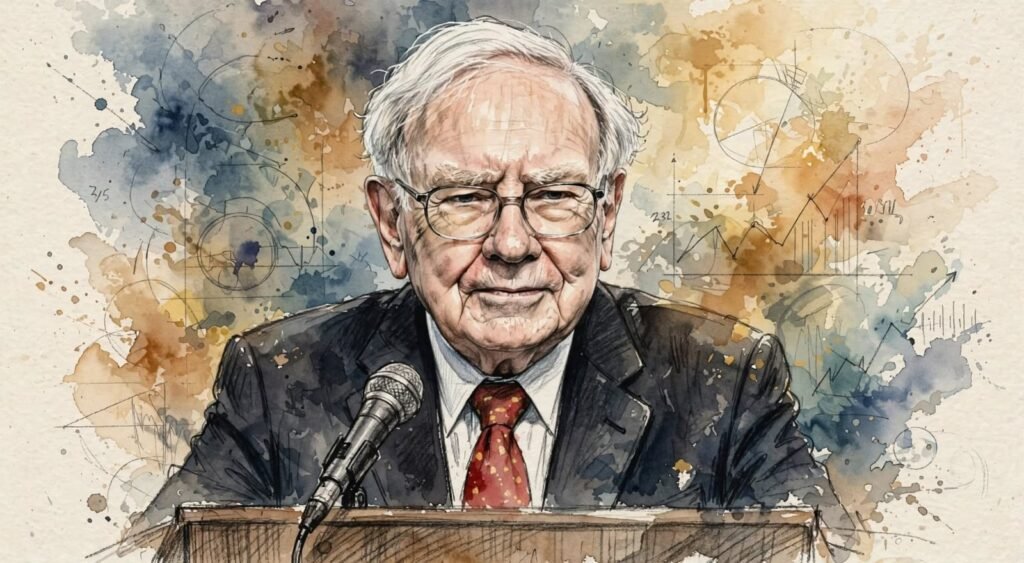
Warren Edward Buffett was born on August 30, 1930, in Omaha, Nebraska. He was the second of three children and the only son of his parents. His father, Howard Buffett, was a stockbroker and was also elected to the U.S. Congress four times.
From childhood, Warren Buffett was interested in making money. He sold soft drinks and delivered newspapers. At just eleven years old, he began working at his father’s stock brokerage firm and made his first investment. At the same age, he bought three preferred shares of Cities Service for $38 per share. When the share price fell and later recovered to $40, he quickly sold them, but the price continued to rise afterward. This experience taught him an important lesson: trying to predict exactly when to buy and sell a stock is not a good idea.
As a teenager, Buffett saved enough money from delivering newspapers to buy 40 acres of farmland in Nebraska, which he later rented out. Even at this early stage, it was clear that Buffett had an unusual ability not only in mathematics but also in understanding business and financial markets.
At the age of seventeen, Buffett enrolled at the Wharton School of the University of Pennsylvania. He later transferred to the University of Nebraska, Lincoln, where he earned a bachelor’s degree in business administration two years later. Harvard Business School rejected his application, so he pursued postgraduate studies at Columbia Business School, where Benjamin Graham became his teacher and later his most influential mentor.
After completing his studies at Columbia, Buffett applied for a job at Graham’s firm, Graham-Newman, but was initially rejected. He returned to Omaha and began working at his father’s brokerage firm. However, in 1954, he was given the opportunity to work at Graham-Newman. Two years later, after Benjamin Graham retired, Buffett returned to Omaha.
In 1956, Buffett established Buffett Associates Ltd. He invested $100 of his own money and raised another $300,000 from friends and relatives. By 1962, the partnership had more than $7.2 million in net assets. That same year, Buffett met Charles T. Munger, who would become an important partner and friend in the years that followed.
In 1962, Buffett began investing in Berkshire Hathaway, a struggling textile company based in New Bedford, Massachusetts. He later described it as the “dumbest” stock purchase of his life. In 1965, he took control of the company and spent nearly 20 years trying to keep the failing textile business going before finally giving up.
At the same time, he began using Berkshire Hathaway as a holding company for the many businesses and stocks he would purchase over the following decades. For many years, Buffett and Charlie Munger worked together informally, and Munger played an important role in changing Buffett’s investment strategy. He helped modify Graham’s approach of buying securities at low prices and selling them when their prices increased. Munger encouraged Buffett to focus instead on buying excellent companies at fair prices and holding them for the long term.
Buffett and Munger both consider the 1972 purchase of See’s Candies an important turning point in their investment journey. In 1970, Buffett became chairman of the board of Berkshire Hathaway and began writing his now-famous annual letters to the company’s shareholders. Soon afterward, he expanded his investments into companies with high-quality products and acquired See’s Candies.
As the price of Berkshire Hathaway shares continued to rise dramatically, Buffett’s reputation as a highly skilled investor spread around the world. He became known as a patient investor who used a systematic approach to identify potential acquisitions and waited for the right market conditions before making purchases. He also developed a management style in which he generally did not interfere in the day-to-day operations of the companies he acquired.
During the 1980s, Berkshire Hathaway’s share price continued to rise, although the 1987 stock market crash dealt the company a severe setback. In less than a year, the investment powerhouse recovered and made one of its most successful investments by purchasing Coca-Cola, eventually acquiring about 7% of the beverage company.
The company’s progress continued through the 1990s and into the new century. By 2016, Berkshire Hathaway’s share price had risen to $217,000, compared with $20 in 1955. Buffett’s wealth also grew dramatically, and in 2017 Forbes ranked him as the world’s second-richest person, with an estimated fortune of $75.6 billion.
Despite his enormous wealth, Buffett remained known for living a simple and frugal life. He continued to live in the same Omaha house that he had purchased in 1958 for $31,500. In 2025, Forbes ranked him tenth on its list of the world’s billionaires and estimated his wealth at $148 billion.
Known as the “Oracle of Omaha,” Warren Buffett is regarded as one of the most successful investors in the world. He served as chairman of Berkshire Hathaway, which owns dozens of companies, including Geico, battery manufacturer Duracell, and restaurant chain Dairy Queen. At the end of 2025, he retired as Chief Executive Officer of Berkshire Hathaway.
Buffett has pledged to give more than 99% of his wealth to charitable causes. In 2010, he and Bill Gates founded the Giving Pledge, which encourages wealthy individuals to donate at least half of their wealth to charitable causes.
Warren Buffett’s Investment Philosophy and the Secrets Behind His Success
Warren Buffett’s investment thinking was not limited to numbers and financial figures. When considering a company, he also looked closely at its management and the competitive advantage of its products in the market. He took the idea of value investing beyond simply finding underpriced companies in difficulty and developed it into a broader investment philosophy.
Buffett was a true value investor. He invested in strong companies that were available at low prices and held them for the long term. His basic principle was to buy shares in well-managed companies whose market prices were below their intrinsic value. When he invested, his intention was generally to hold those shares indefinitely.
Patience and long-term thinking were central to Buffett’s approach to investing. He viewed investments from a long-term perspective rather than focusing on short-term gains. He preferred investments that could be held for many years, and sometimes indefinitely, allowing the power of compounding to work over time. He held shares of companies such as Coca-Cola and American Express for decades.
His approach was systematic and patient. He identified potential investments or companies to acquire and then waited for suitable market conditions before making a purchase. He looked for companies with innovative management, a strong focus on shareholders, and high profit margins, provided that their strong fundamentals were available at a reasonable price.
Buffett was also highly consistent in his decisions. When he refused to invest in companies that did not meet his established standards, Wall Street experts criticized him, and many believed that his time had passed. But when the dot-com bubble burst and technology stocks suffered a sharp decline, many of those experts suffered heavy losses, while Buffett’s profits doubled.
His persistence was also evident when he faced failure and difficult circumstances. Buffett later described his investment in Berkshire Hathaway as his “dumbest” stock purchase. Yet after taking control of the company in 1965, he spent nearly 20 years trying to keep its failing textile business alive before eventually giving up.
The 1987 stock market crash also dealt a severe blow to Berkshire Hathaway’s share price, but in less than a year the investment powerhouse had recovered. The company then made one of its most successful investments in Coca-Cola and soon acquired 7% of the beverage company.
Buffett built his fortune through research, good timing, and a long-term approach. He made highly researched and timely purchases of undervalued stocks and companies and then held them for the long term. In most cases, he allowed the existing management teams to continue running the businesses because, in his view, those managers had done enough to make their companies attractive investments for him.
Buffett followed a simple rule when making investment decisions: if a person is not willing to hold a stock for ten years, they should not even consider buying it for ten minutes. Another of his well-known principles was to be cautious when others are overly greedy and to have the courage to take advantage of opportunities when others are fearful.
Buffett’s investment philosophy, simple lifestyle, and positive approach to business ethics have contributed to his strong reputation. His value-investing philosophy—investing in undervalued stocks with the potential for long-term growth—has become an important strategy for investors around the world.