
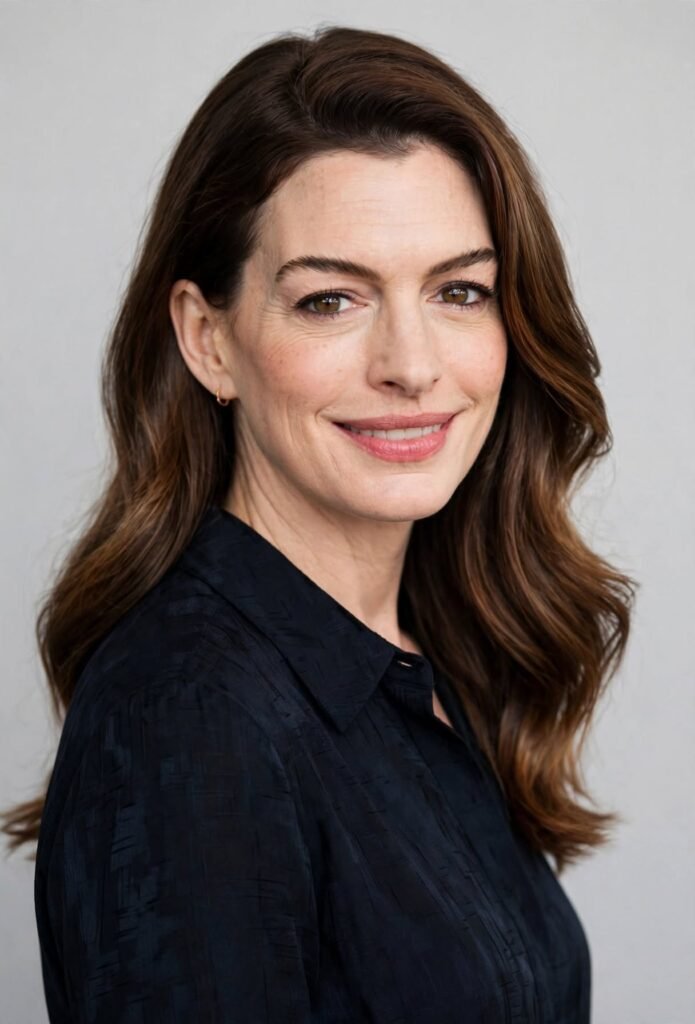
Anne Hathaway has built a remarkable career by moving between lighthearted comedies, romantic dramas, ambitious science-fiction films, and emotionally demanding performances. First recognized as a young actress playing a teenager destined for royalty, she gradually established herself as one of Hollywood’s most versatile performers. From The Princess Diaries and The Devil Wears Prada to Les Misérables and Interstellar, Hathaway has repeatedly demonstrated her ability to embrace very different characters. Her Academy Award-winning performance as Fantine marked a defining moment in her career, while her continued work in film and television has kept her among the most recognizable actresses of her generation.
Early Life and Family Background
Anne Jacqueline Hathaway was born on November 12, 1982, in Brooklyn, New York, United States. She was raised in a family that encouraged an interest in the performing arts. Her father, Gerald Hathaway, worked as a lawyer, while her mother, Kate McCauley Hathaway, was a stage actress. Growing up with a mother who understood the demands of theatrical performance gave Anne an early introduction to the world she would eventually enter professionally.
When Hathaway was six years old, her family moved from Brooklyn to Millburn, New Jersey. The suburban community became the setting for much of her childhood and formative education. Her mother’s involvement in theater exposed her to live performance at an early age, and Hathaway soon developed an interest in acting herself.
One particularly meaningful influence came from her mother’s work in the musical Les Misérables. Hathaway accompanied her mother during a production of the show and became familiar with its characters and emotional storytelling. Years later, she would portray Fantine in a major film adaptation of the same musical, connecting a childhood theatrical experience with one of the most important achievements of her professional life.
Discovering Acting and Developing Her Skills
Hathaway’s interest in performing developed into a serious ambition during her teenage years. She participated in student productions and pursued formal acting instruction, eventually becoming the first and only teenager accepted into the Barrow Group, a respected New York theater company and acting school.
Her training helped prepare her for the practical demands of professional performance. Rather than relying solely on her natural enthusiasm, she worked to develop the discipline and skills required for both stage and screen acting.
Hathaway also continued her education after graduating from high school in 2000. She attended Vassar College, where she studied English, before transferring to New York University’s Gallatin School of Individualized Study. Her academic interests complemented her acting ambitions, giving her opportunities to explore literature and other subjects while pursuing a career in entertainment.
Her first significant professional opportunity arrived before she had completed her transition into adulthood. At approximately 16 years old, she secured a role in the television drama Get Real, which aired from 1999 to 2000. She played Meghan Green, the eldest daughter in a family navigating the complications of everyday life.
Although the series lasted only one season, it introduced Hathaway to a professional television production and provided an early opportunity to demonstrate her abilities. Her performance earned a Teen Choice Award nomination, offering an encouraging sign that her work was attracting attention.
The Breakthrough: The Princess Diaries
Hathaway’s career changed dramatically in 2001 when she made her feature-film debut in Disney’s The Princess Diaries. Directed by Garry Marshall, the family comedy starred her as Mia Thermopolis, an awkward teenager who discovers that she is the heir to the throne of the fictional European kingdom of Genovia.
Mia’s transformation from an ordinary schoolgirl into a young woman learning the responsibilities of royalty gave Hathaway an opportunity to combine comedy, vulnerability, and youthful charm. She shared the screen with Julie Andrews, who played Mia’s grandmother, Queen Clarisse Renaldi.
The film became a commercial success, earning approximately $108 million at the worldwide box office according to contemporary entertainment reporting. Its popularity introduced Hathaway to a broad international audience and established her as a promising young Hollywood actress.
The role also created an early association between Hathaway and family-oriented entertainment. However, the success of The Princess Diaries was only the beginning of a career that would eventually encompass darker dramas, sophisticated comedies, action films, and complex character studies.
In 2004, she returned as Mia in The Princess Diaries 2: Royal Engagement. The sequel continued the character’s story as she faced new expectations surrounding her future as queen. That same year, Hathaway starred in Ella Enchanted, a fantasy comedy that reimagined the Cinderella tradition. These projects reinforced her position as a leading performer in family films while allowing her to develop her screen presence.
Moving Beyond Family Films
As Hathaway’s public profile grew, she began accepting roles that differed considerably from the cheerful, youthful characters that had first brought her fame. She appeared in Havoc (2005), an independent drama about privileged teenagers drawn into a more dangerous urban environment.
The film represented a departure from her earlier screen image. Rather than playing an innocent or idealistic young woman, Hathaway explored a character involved in more adult and challenging circumstances.
Her next major step came with Ang Lee’s acclaimed drama Brokeback Mountain (2005). Starring Heath Ledger and Jake Gyllenhaal, the film told the story of two men whose romantic relationship unfolds over many years in a society that makes their love difficult to express openly.
Hathaway played Lureen Newsome, the wife of Gyllenhaal’s character, Jack Twist. Her role required her to portray a woman whose marriage is shaped by emotional distance and circumstances she does not fully understand. The film received widespread critical recognition and was nominated for the Academy Award for Best Picture.
Her involvement in the production helped establish her credibility in serious dramatic cinema. It also demonstrated that she was willing to take on supporting roles in projects driven by challenging material rather than relying exclusively on the leading parts that had made her famous.
Global Recognition Through The Devil Wears Prada
In 2006, Hathaway starred alongside Meryl Streep and Emily Blunt in The Devil Wears Prada, a comedy-drama based on Lauren Weisberger’s bestselling novel.
Hathaway portrayed Andrea Sachs, an aspiring journalist who accepts a position as an assistant to Miranda Priestly, the formidable editor of a leading fashion magazine. Streep played Miranda, while Blunt appeared as another assistant navigating the demanding workplace.
The film explored ambition, professional pressure, personal priorities, and the compromises that can accompany success. Hathaway’s character gradually changed as she became more familiar with the fashion industry and its expectations, creating a central conflict between career advancement and personal identity.
The film achieved major commercial success, earning approximately $326 million worldwide according to Variety’s reporting. Its enduring popularity also made Andrea Sachs one of Hathaway’s best-known roles.
Working with Streep provided Hathaway with an opportunity to share the screen with an established figure in American cinema. The production further strengthened her standing in Hollywood and showed that she could lead a successful film aimed at adult audiences.
For Hathaway, The Devil Wears Prada was an important turning point. She had moved beyond the identity of a promising young actress from Disney productions and become a performer capable of anchoring a commercially successful film with an international audience.
Exploring Historical Drama and Complex Characters
After the success of The Devil Wears Prada, Hathaway continued to diversify her filmography. In 2007, she portrayed the English novelist Jane Austen in Becoming Jane, a historical romantic drama that presented a fictionalized account of Austen’s early life and a possible romantic relationship with an Irish lawyer played by James McAvoy.
The role required Hathaway to adopt an English accent and inhabit a character associated with one of literature’s most enduring writers. It also continued her movement toward period dramas and performances that demanded a different approach from contemporary comedy.
In 2008, she appeared in the action comedy Get Smart, opposite Steve Carell, and the psychological thriller Passengers. However, her most consequential performance that year came in Jonathan Demme’s Rachel Getting Married.
Hathaway played Kym, a woman returning home from rehabilitation to attend her sister’s wedding. The character struggles with addiction and the lasting consequences of her actions on her family. The film placed considerable emphasis on emotional tension, complicated relationships, and the possibility of reconciliation.
Hathaway’s performance received strong critical praise and earned her an Academy Award nomination for Best Actress. It marked a major milestone in her development as a dramatic performer and demonstrated that she could carry a demanding independent film as effectively as a mainstream studio production.
The nomination also distinguished her from the conventional image of a young romantic-comedy star, positioning her as an actress capable of tackling difficult and emotionally layered material.
Romantic Comedies and Commercial Success
Despite her increasing recognition as a dramatic actress, Hathaway continued to work in comedy and romance. In 2009, she starred opposite Kate Hudson in Bride Wars, a comedy about two longtime friends whose wedding plans turn into a rivalry after their ceremonies are scheduled for the same date.
The film received mixed reviews but performed well enough commercially to expand Hathaway’s presence in the romantic-comedy market.
In 2010, she joined a large ensemble cast for Valentine’s Day, a romantic comedy that followed several interconnected relationships. The same year, she appeared in Tim Burton’s Alice in Wonderland, playing the White Queen in a visually elaborate adaptation of Lewis Carroll’s classic story.
The film became a major commercial success, introducing Hathaway to another generation of fantasy-film audiences and giving her a role that contrasted with her more grounded performances.
Also in 2010, Hathaway starred opposite Jake Gyllenhaal in Love & Other Drugs. She played Maggie Murdock, a free-spirited woman living with Parkinson’s disease who develops a relationship with a pharmaceutical salesman. The film combined romantic comedy with a more serious examination of illness, independence, and intimacy.
In 2011, she appeared in One Day, a romantic drama adapted from David Nicholls’s novel. The story followed two people whose relationship developed over many years, allowing Hathaway to portray a character whose ambitions and personal circumstances evolved with time.
These projects demonstrated her continuing ability to move between commercial entertainment and films that explored more difficult personal experiences.
A Defining Year: The Dark Knight Rises and Les Misérables
The year 2012 became one of the most important periods of Hathaway’s career. She appeared in two major productions that showcased very different aspects of her acting.
In Christopher Nolan’s The Dark Knight Rises, the final installment of his Batman trilogy, Hathaway played Selina Kyle, the skilled thief known as Catwoman. Her performance combined physical action, intelligence, and a morally complicated character who operated between criminal activity and the larger conflict surrounding Gotham City.
The film was a worldwide box-office success, earning more than $1 billion globally. It further strengthened Hathaway’s reputation as an actress capable of taking on prominent roles in large-scale productions.
Her second major achievement of the year came with Les Misérables, Tom Hooper’s film adaptation of the stage musical based on Victor Hugo’s novel. Hathaway portrayed Fantine, a struggling mother who loses her job and makes increasingly painful sacrifices to provide for her young daughter, Cosette.
The role required Hathaway to perform emotionally intense scenes and sing as part of the film’s musical storytelling. Fantine’s suffering and determination gave the actress an opportunity to deliver one of the most demanding performances of her career.
The connection to her childhood experience of watching her mother perform in Les Misérables made the role especially notable in the context of her life story.
Hathaway received extensive acclaim for her portrayal of Fantine. In January 2013, she won the Golden Globe Award for Best Supporting Actress in a Motion Picture. The following month, she received the Academy Award for Best Supporting Actress, along with a BAFTA Film Award and a Screen Actors Guild Award for her performance.
The Oscar represented her first Academy Award victory and confirmed her position among Hollywood’s leading performers. It also completed a significant professional progression: from a teenage actress in a family television drama to an internationally recognized performer celebrated for her work in a major musical adaptation.
Expanding Her Range: Interstellar and The Intern
Following her awards success, Hathaway continued to pursue a variety of projects rather than remaining within a single genre.
In 2014, she reunited with director Christopher Nolan for Interstellar, a science-fiction drama about humanity’s search for a habitable planet as environmental collapse threatens Earth’s future. Hathaway played Dr. Amelia Brand, a scientist and astronaut involved in the mission to find a new home for humanity.
The film combined scientific ideas with questions about family, sacrifice, time, and survival. Its ambitious scale provided Hathaway with another opportunity to participate in a major production that differed significantly from her earlier romantic comedies and historical dramas.
She also returned to voice acting as Jewel, a blue macaw, in the animated films Rio (2011) and Rio 2 (2014), reaching younger audiences through a separate branch of her career.
In 2015, Hathaway starred opposite Robert De Niro in The Intern. She played Jules Ostin, the founder of an online fashion company who hires a retired widower as a senior intern. The comedy examined workplace culture, generational differences, and the pressures of managing a growing business while maintaining a personal life.
The role allowed Hathaway to portray a successful professional whose confidence and ambition coexist with the demands of leadership. It also continued her collaboration with established actors while placing her at the center of a contemporary workplace story.
In 2016, she returned as the White Queen in Alice Through the Looking Glass, the sequel to Alice in Wonderland. That year, she also starred in Colossal, a dark comedy in which her character discovers an unusual connection between her movements and a gigantic creature appearing in South Korea.
The latter project offered a more unconventional role, combining comedy, fantasy, and themes of personal responsibility.
Ocean’s 8 and a New Generation of Ensemble Films
In 2018, Hathaway joined Sandra Bullock, Cate Blanchett, Rihanna, Helena Bonham Carter, and other performers in Ocean’s 8, a heist comedy that reimagined the Ocean’s Eleven franchise around a team of women planning a high-profile robbery.
Hathaway played Daphne Kluger, a famous actress whose public image and self-importance become central to the film’s elaborate scheme. Her performance drew favorable reviews, particularly for its willingness to make the glamorous character both amusing and deliberately exaggerated.
The film demonstrated her ability to participate in an ensemble production while creating a memorable character of her own.
In 2019, Hathaway appeared in several projects across different formats. She starred with Matthew McConaughey in the thriller Serenity, played a con artist opposite Rebel Wilson in The Hustle, and appeared in an episode of the romantic anthology series Modern Love.
Her episode of Modern Love focused on a woman living with mental illness and explored the effects of her condition on romantic relationships and everyday life. Hathaway’s performance brought a more intimate dramatic dimension to a series built around stories of love and human connection.
She also starred alongside Mark Ruffalo in Dark Waters, a fact-based legal drama concerning allegations that a chemical company had contaminated a community. The film examined corporate responsibility and the challenges of pursuing accountability through the legal system.
Together, these projects illustrated the breadth of Hathaway’s professional interests, from mainstream comedy to character-driven drama and socially relevant storytelling.
Career Developments in the 2020s
Hathaway continued working across film genres in the early 2020s. In 2020, she starred in The Last Thing He Wanted, a political crime drama adapted from Joan Didion’s novel, and The Witches, a fantasy film based on Roald Dahl’s children’s book.
In 2021, she appeared in Locked Down, a heist comedy-drama set against the circumstances of the COVID-19 pandemic. She also joined the science-fiction anthology series Solos, which explored different aspects of the human experience through largely self-contained stories.
One of her prominent television projects followed in 2022, when she starred opposite Jared Leto in WeCrashed. The limited series dramatized the rise and fall of WeWork, the company that became known for its shared-office business model. Hathaway portrayed Rebekah Neumann, whose relationship with her husband and involvement in the company’s culture formed an important part of the story.
The same year, she appeared in James Gray’s Armageddon Time, a coming-of-age drama that examined family, privilege, racism, and the experiences of a sixth-grade boy growing up in New York during the 1980s.
In 2023, Hathaway starred in Eileen, a psychological drama adapted from Ottessa Moshfegh’s novel. She played Rebecca, a woman whose arrival at a correctional facility draws a younger coworker into an increasingly complicated relationship. The film offered another example of Hathaway’s interest in characters whose public appearances conceal more troubling or uncertain dimensions.
Her film choices continued to reflect a willingness to alternate between large studio productions and smaller, more psychologically focused stories.
The Idea of You and Mother’s Instinct
In 2024, Hathaway starred in The Idea of You, a romantic drama based on Robinne Lee’s novel. She played Solène, a divorced mother who begins a relationship with Hayes Campbell, a much younger singer in a popular boy band.
The story explored romance, public scrutiny, age differences, and the challenges faced by women whose personal lives become subjects of intense attention. Hathaway’s performance placed an adult woman’s desires and independence at the center of a contemporary romantic narrative.
She also appeared with Jessica Chastain in Mother’s Instinct, a psychological thriller set in the 1960s. The film follows two women whose close friendship begins to deteriorate after a tragic event. Its themes of grief, suspicion, and psychological uncertainty offered Hathaway another departure from conventional romantic comedy.
These releases continued a career pattern established years earlier: balancing accessible commercial films with projects that give her room to explore morally complicated or emotionally demanding characters.
Recent Projects and Continuing Career
Hathaway’s work continued to develop through 2025 and 2026, with several projects extending her presence across major film productions.
She starred in Mother Mary, a drama in which she portrayed a pop star attempting to stage a comeback with the assistance of a former friend and choreographer, played by Michaela Coel. The project explored the intersection of celebrity, artistic identity, and personal relationships.
Hathaway also returned to the world of The Devil Wears Prada with The Devil Wears Prada 2, reuniting with a franchise that had played a decisive role in her rise to international stardom.
Another project, The End of Oak Street, placed her in a thriller involving a suburban neighborhood threatened by rampaging dinosaurs. The production represented a further expansion of the genres in which she has worked.
In 2026, Hathaway appeared in Christopher Nolan’s The Odyssey, playing Penelope, the wife of the Greek hero Odysseus. The epic adventure drew on the ancient Greek story of Odysseus’s long journey home following the Trojan War. Her casting brought her back into collaboration with Nolan after their work on The Dark Knight Rises and Interstellar.
Taken together, these projects reflect the continued diversity of Hathaway’s screen career. Rather than being defined by one famous character or genre, she has maintained a presence in romantic drama, comedy, psychological thrillers, science fiction, and large-scale literary adaptations.
Theater, Singing, and Television Work
Although Hathaway is best known for her film performances, her professional experience also includes theater and singing.
Her vocal abilities became particularly visible in Les Misérables, but her interest in music began much earlier. In 1999, she performed as part of an honors chorus at Carnegie Hall in New York City, demonstrating an ability that would later become important to her screen work.
She made her New York stage debut in the musical Carnival in 2002. In 2009, she appeared as Viola in a Shakespeare in the Park production of Twelfth Night, taking on a classic theatrical role outside the world of film.
In 2015, she returned to the stage in Julie Taymor’s production of Grounded at the Public Theater, playing a fighter pilot. The role placed her in a contemporary dramatic work that differed substantially from the fantasy and comedy productions associated with much of her early career.
Hathaway also took on a high-profile hosting assignment in 2011, when she cohosted the Academy Awards ceremony with actor James Franco. The event gave her an opportunity to appear as a presenter and entertainer rather than as a performer promoting a particular film.
Her work across these different formats reflects a career built not only on screen visibility but also on theatrical training, musical ability, and a willingness to explore varied forms of performance.
Awards and Professional Recognition
Hathaway’s career has earned recognition from several major organizations in the entertainment industry. Her most prominent honor is the Academy Award for Best Supporting Actress, which she received in 2013 for Les Misérables.
She has also won a Golden Globe Award and a BAFTA Film Award for the same performance, along with a Screen Actors Guild Award. These honors reflected the critical reception of her portrayal of Fantine and helped establish the film as a major milestone in her career.
Her performance in Rachel Getting Married earned an earlier Academy Award nomination, demonstrating that critical recognition of her dramatic abilities had emerged several years before her Oscar victory.
Hathaway also received a Primetime Emmy Award for Outstanding Voice-Over Performance in 2010, reflecting her work in voice acting. Her career has included numerous additional nominations and honors, illustrating the range of projects through which she has attracted industry attention.
Her professional achievements span family entertainment, independent cinema, large-scale action films, musicals, television, and theater. This diversity has become one of the defining features of her career.
Personal Life, Marriage, and Children
Away from the screen, Hathaway has maintained a family life alongside her acting career. She married actor and jewelry designer Adam Shulman on September 29, 2012. The couple had been dating for approximately four years before their wedding.
Their first son, Jonathan Rosebanks Shulman, was born on March 24, 2016, in Los Angeles. Their second son, Jack, was born in late 2019.
Hathaway has generally kept much of her family life separate from the public focus on her professional work, although her marriage and motherhood have occasionally been discussed in interviews and entertainment coverage.
Before her relationship with Shulman, she dated Italian real estate developer Raffaello Follieri. Their relationship ended in 2008 amid a legal scandal involving allegations that Follieri had defrauded investors and falsely represented his authority to manage Vatican financial affairs. Those allegations concerned Follieri, rather than Hathaway.
Her life outside acting has also included charitable involvement. She has supported organizations including the Step Up Women’s Network, which works to empower girls and women, and the Lollipop Theater Network, which provides entertainment experiences for children facing serious medical challenges.
These activities form another part of her public profile beyond her work in film and television.
Anne Hathaway’s Enduring Place in Hollywood
Anne Hathaway’s career illustrates how an actor can grow beyond the role that first establishes public recognition. Her early success as Mia Thermopolis introduced her to audiences around the world, while films such as Brokeback Mountain, The Devil Wears Prada, and Rachel Getting Married demonstrated her willingness to pursue increasingly varied material.
Her performances in The Dark Knight Rises and Les Misérables in 2012 represented a particularly important turning point, combining commercial success with major awards recognition. Subsequent appearances in Interstellar, The Intern, Ocean’s 8, WeCrashed, and The Idea of You continued to broaden her professional range.
Hathaway’s career has not followed a single path. She has moved between blockbuster productions and independent films, romantic comedies and serious dramas, animated features and theatrical performances. That flexibility has allowed her to remain active across changing entertainment trends while returning to roles and franchises that have resonated with audiences.
With her Academy Award, Golden Globe, BAFTA, and Emmy recognition, she has established a substantial record of professional achievement. Her continuing involvement in ambitious film projects, including major productions released or scheduled during 2025 and 2026, demonstrates that her career remains an evolving body of work.
From her childhood exposure to theater in New Jersey to her position as an internationally recognized actress, Hathaway’s story is one of sustained professional development. Her legacy rests not on a single performance, but on the variety of characters she has brought to life and the range of cinematic worlds she has helped create.