
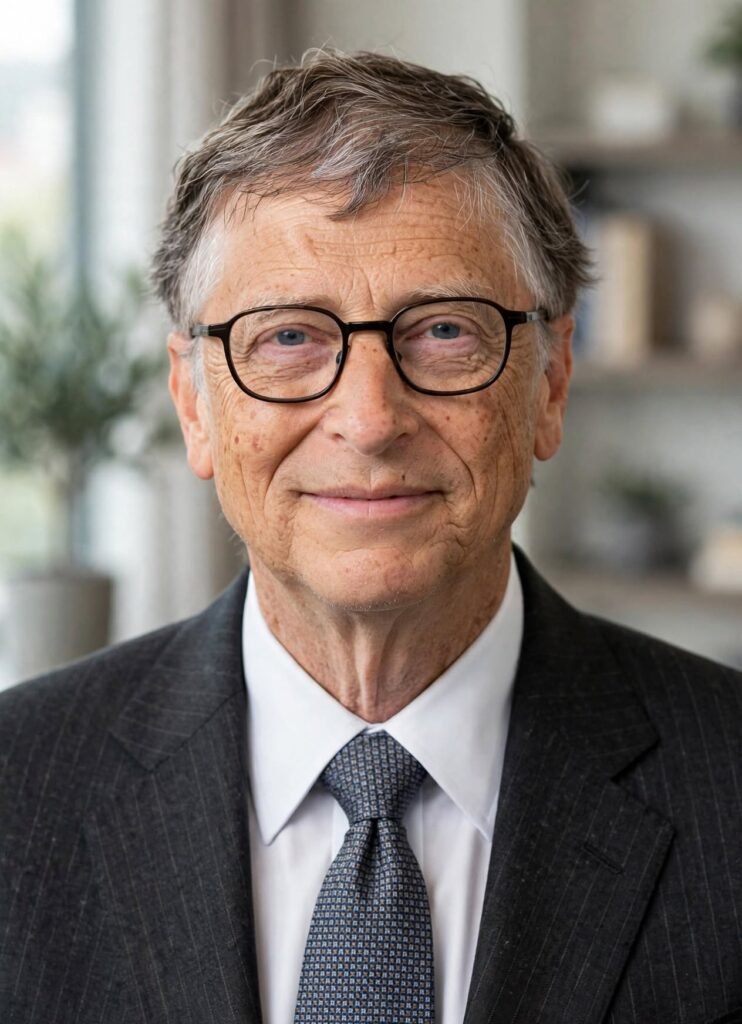
Bill Gates is an American businessman, computer programmer, and philanthropist best known for co-founding Microsoft with his childhood friend Paul Allen. His work helped make personal computers widely useful in homes and businesses. After spending decades building Microsoft into a leading software company, Gates gradually shifted his attention towards global health, education, poverty reduction, and clean energy.
William Henry Gates III was born on October 28, 1955, in Seattle, Washington, United States. He was the second of three children and the only son of William H. Gates Sr., a lawyer, and Mary Maxwell Gates, who was involved in educational and civic activities. His family called him Trey. From an early age, he showed strong curiosity and an interest in learning. He enjoyed reading, particularly books about different subjects, and reportedly read large portions of his family’s encyclopedia while still a child.
Gates was competitive and preferred activities such as skiing and Boy Scouts to team sports. He sometimes struggled socially and was known for his stubborn nature. His parents sought professional advice when he was in sixth grade because of his behaviour. However, his curiosity and determination eventually became important parts of his approach to work and business.
His interest in computers developed at Lakeside School, a private school in Seattle that he attended during his early teenage years. The school provided access to a computer terminal connected to a mainframe computer, giving Gates an opportunity to explore programming at a time when computers were still uncommon. He spent many hours learning how to write programs and created his first software program, a simple tic-tac-toe game, at around thirteen.
At Lakeside, Gates met Paul Allen, a student who shared his interest in technology and was two years older than him. Their friendship developed around computers and programming. Along with other students, they worked on software projects, including programs for school payroll and traffic data. Their early experience gave them practical knowledge of how programming could solve real-world problems. Gates and Allen also established a small business called Traf-O-Data, which developed systems for processing traffic-counting information.
In 1973, Gates entered Harvard University, initially planning to study pre-law. However, computers continued to attract most of his attention. He took advanced mathematics and computer science courses and became friends with Steve Ballmer, who would later join Microsoft. Although Gates had access to a respected university education, he remained more interested in the opportunities emerging in the computer industry.
A major turning point came in late 1974, when Allen showed him a magazine article about the Altair 8800, an early personal computer developed by Micro Instrumentation and Telemetry Systems (MITS). The machine created a new opportunity for software developers because it needed programs that would allow users to operate it effectively.
Gates and Allen contacted MITS and offered to develop a version of the BASIC programming language for the computer. Although their software was not yet ready, they believed they could produce it. They then worked intensively for several weeks to create a working version. After Allen successfully demonstrated the program to MITS in 1975, the company agreed to distribute it under a licensing arrangement.
The success of this project encouraged Gates and Allen to establish their own software business. In 1975, they founded Micro-Soft, a name later shortened to Microsoft. Gates took a leave of absence from Harvard to pursue the venture and eventually left the university without completing his degree. He moved to New Mexico, where the company initially operated, while Allen worked with MITS for a period.
Gates approached the new business with considerable intensity. He was known for working long hours and paying close attention to technical details. Rather than treating software as an accessory to computer hardware, he believed it could become a major business in its own right. This view helped shape Microsoft’s direction as the personal computer industry began to develop.
In 1979, Microsoft moved its operations to Bellevue, Washington, near Seattle. The following year brought one of the company’s most important opportunities when IBM sought an operating system for its first personal computer. Microsoft did not own a suitable operating system at the time, so Gates arranged to acquire an existing system and adapt it for IBM’s machine. The resulting product became known as MS-DOS.
The agreement with IBM proved especially valuable because Microsoft retained the right to license MS-DOS to other computer manufacturers. As IBM-compatible computers spread, other companies could use Microsoft’s software without requiring the company to develop a completely separate operating system for each manufacturer. This arrangement helped Microsoft expand its reach throughout the growing personal computer market.
Gates’s business approach differed from the view that hardware manufacturers should control the entire computing experience. He recognised that software could be sold across many different machines, creating opportunities for a much larger market. By the early 1980s, Microsoft was growing rapidly, and Gates had become the company’s leading executive. Paul Allen left his active role at Microsoft in 1983 because of health concerns, while Gates continued to direct its development.
During this period, Gates developed a reputation as a demanding and highly competitive businessman. He took part in hiring decisions and sought technically capable employees, including talented university graduates. Microsoft offered a relatively informal workplace, but its employees faced high expectations and a demanding pace of work. Gates’s management style attracted criticism from people who considered him arrogant or difficult, although others admired his technical knowledge, business judgement, and willingness to challenge established ideas.
Microsoft continued to grow through the middle of the 1980s. Its software sales increased, and the company introduced products that helped make computers more accessible to ordinary users. Microsoft went public in 1986, creating substantial wealth for Gates through his shareholding. In 1987, at the age of 31, he became the world’s youngest billionaire at that time.
Another important development was the introduction of Windows. Released in 1985, the first version offered a graphical interface for personal computers, and Windows 3.0, launched in 1990, became a major commercial success. Its more accessible design and ability to run multiple applications helped attract a wider range of users. Microsoft continued improving the system, strengthening its position in the computer industry.
Gates also understood that Microsoft needed to adapt as technology changed. When public interest in the internet grew during the mid-1990s, the company increased its focus on internet-based software and services. Microsoft introduced Internet Explorer with Windows 95, allowing users to browse the web through software integrated into the company’s operating system. Internet Explorer later became one of the dominant web browsers of its time.
The expansion of Microsoft made Gates one of the world’s wealthiest individuals. Forbes ranked him as the world’s richest person for many years, including an uninterrupted period from 1995 to 2007. In 1999, his estimated wealth briefly exceeded $100 billion, making him the first person to reach that level of personal wealth. His fortune reflected Microsoft’s commercial success, although the company’s growing influence also brought legal and public scrutiny.
In May 1998, the United States Department of Justice and several states brought an antitrust case against Microsoft. The authorities alleged that the company had used its market power to limit competition, particularly in the web-browser market. The case damaged Gates’s public image and raised questions about Microsoft’s business practices. A proposed order to divide the company was later overturned on appeal, and the dispute ended through a settlement.
Alongside his professional responsibilities, Gates developed a personal life and family. Microsoft hired Melinda French in 1987, and the two eventually began a relationship. They married on January 1, 1994, in Hawaii and had three children. Their family home was in Medina, Washington, near Seattle. Gates continued to lead Microsoft during the 1990s, while also becoming increasingly involved in charitable activities.
In 1994, Gates and his then-wife established the William H. Gates Foundation, which initially supported global health programmes and projects in the Pacific Northwest. It was later renamed the Bill & Melinda Gates Foundation. The couple also supported educational opportunities, library programmes, and scholarships. Over time, their charitable work expanded considerably, with particular attention to public health, education, and reducing poverty.
By the late 1990s, Gates had become more publicly involved in philanthropy. In 2000, he and Melinda brought their charitable work together through the Bill & Melinda Gates Foundation, which grew into one of the world’s largest private philanthropic organisations. The foundation funded initiatives aimed at improving healthcare, supporting education, and addressing poverty in the United States and other countries.
Gates’s role at Microsoft began to change around the turn of the century. In 2000, Steve Ballmer succeeded him as chief executive officer, while Gates remained chairman and became chief software architect. This allowed him to concentrate more on the company’s technology direction while Ballmer managed its daily business operations.
In 2006, Gates announced that he would gradually reduce his involvement in Microsoft’s day-to-day activities. The transition took effect in 2008, when he devoted much more of his time to the foundation. He remained chairman of Microsoft until February 2014, after which he became a technology adviser to the company and supported the transition to Satya Nadella’s leadership. Gates resigned from Microsoft’s board in March 2020, although he continued to provide advice on technology matters.
As his attention shifted towards philanthropy, Gates became increasingly involved in efforts to tackle infectious diseases. The foundation supported programmes addressing malaria, tuberculosis, polio, and other major health challenges. It also invested in vaccination initiatives, maternal and child health, and improving access to healthcare in lower-income countries.
In 2006, investor Warren Buffett announced a major commitment to the foundation, helping expand its ability to fund charitable programmes. Four years later, Gates and Buffett launched the Giving Pledge, an initiative encouraging wealthy individuals to commit most of their fortunes to charitable causes during their lifetimes or through their estates. Gates became one of the most prominent supporters of the idea that significant private wealth could be used to address social problems.
Gates also turned his attention to climate change and energy research. In 2008, he founded TerraPower, a company working on advanced nuclear energy technology. He argued that new energy systems and increased investment in research would be necessary to meet growing energy needs while reducing emissions. In 2015, he pledged financial support for clean energy research and encouraged governments and private investors to increase their spending in this area. TerraPower later began construction preparations for an advanced nuclear power project in Wyoming, with the goal of developing a new type of reactor.
His philanthropic interests expanded into research on diseases that affect ageing populations. In 2017, Gates contributed $100 million towards organisations studying dementia and Alzheimer’s disease. During the COVID-19 pandemic in 2020, the Gates Foundation announced additional funding for vaccine development and other efforts to combat the disease.
In March 2020, Gates left Microsoft’s board to concentrate more fully on philanthropy, global health, education, and climate change. However, his personal life also underwent a major change. In May 2021, he and Melinda announced that they were ending their marriage after 27 years. Their divorce was finalised in August that year. Both continued their charitable work for a time, but Melinda French Gates stepped down as co-chair of the foundation in 2024. Gates subsequently became its sole chair, and the organisation adopted the name Gates Foundation in 2025.
Gates continued to direct much of his wealth towards philanthropy. In May 2025, he announced plans to give away 99% of his remaining fortune through the foundation over the following two decades. He said the organisation would focus its resources on areas where it could make a substantial difference, including ending polio, reducing childhood malnutrition, and fighting diseases such as malaria. Under this plan, the foundation is expected to close by December 31, 2045.
His interests have also included artificial intelligence and its potential effects on society. In 2026, Gates warned that AI could bring major advances in healthcare, education, agriculture, and scientific research, but could also disrupt employment and create new security risks. He called for governments and institutions to prepare for these changes and consider ways to protect people who might be negatively affected by the technology.
In February 2025, Gates published Source Code: My Beginnings, the first of a planned three-part memoir series. The book explores his childhood, school years, and early experiences that shaped his interest in computers. It provides a more personal account of his development before Microsoft’s rise transformed his life.
Gates has received numerous honours for his work in technology and philanthropy. Among them are the Knight Commander of the Order of the British Empire in 2005, the Presidential Medal of Freedom in 2016, and Pakistan’s Hilal-e-Pakistan in 2022. He has also been widely recognised for his influence on the development of personal computing and his contributions to global health and education.
As of October 2026, Gates remains active in philanthropy and technology-related initiatives. Forbes estimated his net worth at approximately $116 billion in October 2026, although wealth estimates vary with market conditions and the value of his assets. His fortune has also been affected by the large amounts he has donated to charitable causes.
Bill Gates’s career reflects a combination of technical interest, commercial ambition, and an ability to recognise emerging opportunities. His early belief that software would become central to personal computing helped establish Microsoft as a major technology company. His later decision to devote much of his time and wealth to philanthropy shifted his focus from building a business to addressing global problems. While his business methods and Microsoft’s market power have attracted criticism, his influence on computing and his sustained involvement in charitable work have made him one of the most widely recognised figures in modern technology.