
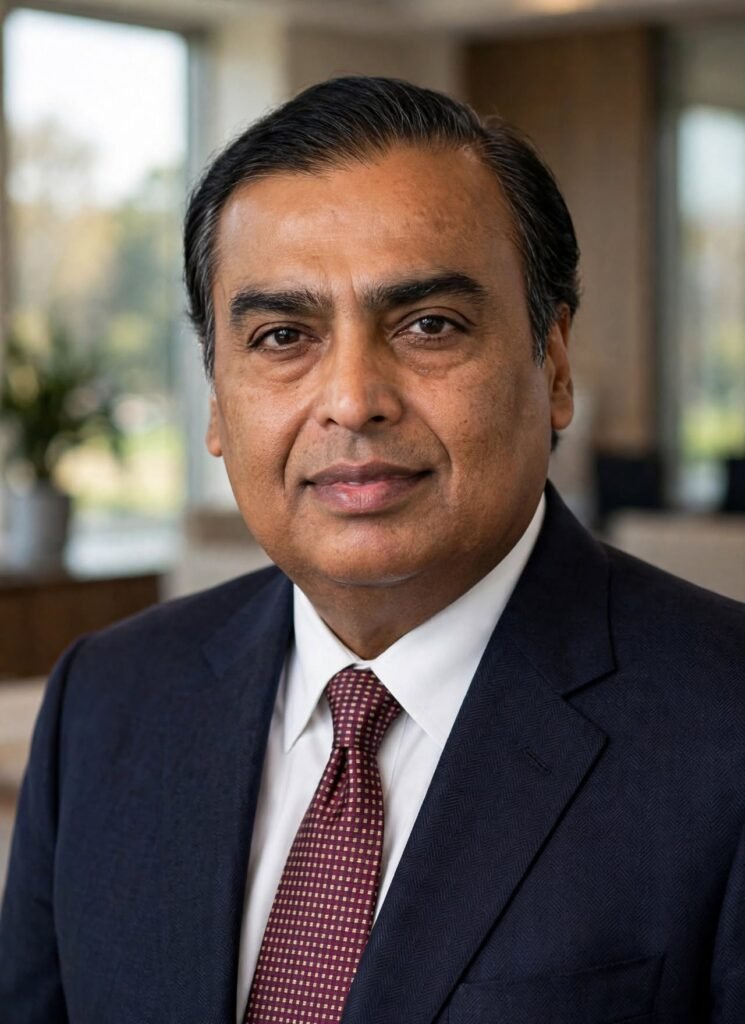
Mukesh Dhirubhai Ambani is an Indian businessman best known for leading Reliance Industries Limited, one of India’s largest companies. Under his leadership, Reliance expanded from its traditional businesses into telecommunications, retail, digital services, and other industries. His career reflects a long-term approach to business growth, large-scale investment, and the ability to enter new markets.
Mukesh Ambani was born on April 19, 1957, in Aden, which was then a British colony and is now part of Yemen. He was the eldest son of Dhirubhai Ambani and Kokilaben Ambani. His father later became the founder of Reliance Industries. In 1958, the family moved to Bombay, now known as Mumbai, India, partly because of the uncertain political situation in Aden.
During his childhood, the Ambani family lived in a modest apartment in a shared residential building. Their circumstances improved as Dhirubhai’s business grew, and the family eventually moved to a wealthier neighbourhood. However, Dhirubhai wanted his children to understand the value of money, education, and practical life skills. Despite the family’s growing financial position, Mukesh and his siblings were encouraged to remain familiar with ordinary people’s lives and experiences.
Mukesh attended school in Mumbai and later studied at St. Xavier’s College. He went on to earn a bachelor’s degree in chemical engineering from the Institute of Chemical Technology, then known as the University Department of Chemical Technology, in Bombay. His education provided a technical foundation that would become useful in his future work in manufacturing and the petrochemical industry.
In 1979, Ambani enrolled in a master’s degree programme in business administration at Stanford University in the United States. However, he did not complete the programme. His father wanted him to gain practical business experience and called him back to India to help expand the family enterprise. Around 1981, Mukesh joined Reliance Industries and began taking on greater responsibilities in its development.
At the time, Reliance was growing beyond its original trading and textile activities. Mukesh played an important role in expanding the company’s manufacturing operations, particularly in polyester fibres and petrochemicals. He was involved in the development of a yarn manufacturing project and learned to manage complex industrial operations. His work required attention to production, planning, and the practical details of running large facilities. These experiences helped prepare him for broader leadership responsibilities.
During the 1980s, Reliance continued to expand, and Mukesh gradually became more involved in its major decisions. His responsibilities increased further when his father’s health began to decline in the late 1980s. Rather than limiting the company to its existing businesses, Mukesh supported expansion into related industries, including petroleum refining and oil and gas exploration.
One of his most significant projects was the development of Reliance’s petroleum refining complex at Jamnagar in Gujarat. The first refinery became operational in 1999, creating a major centre for petroleum processing and industrial production. A second refinery was added nearby in 2008. Together, these facilities strengthened Reliance’s position in the energy and petrochemical sectors and helped it develop a much larger industrial base.
Dhirubhai Ambani died in 2002 without leaving a clear division of business responsibilities between his sons. Mukesh and his younger brother, Anil Ambani, initially shared leadership of the Reliance businesses, but disagreements over control eventually led to a division of the family empire. Their mother, Kokilaben, helped bring about a settlement. Under the arrangement reached in 2005–06, Mukesh took control of Reliance Industries’ oil, gas, and petrochemical businesses, while Anil received businesses that included telecommunications, power generation, and financial services. A non-compete agreement between the two groups was later cancelled in 2010.
After the division, Mukesh concentrated on developing Reliance Industries into a diversified business group. The company continued investing in energy and manufacturing while moving into industries that served India’s expanding consumer market. One major development was Reliance Retail, launched in 2006. The business grew into a large network of physical stores and online operations, selling products across several retail categories. It also sought to connect farmers and suppliers with wider markets while creating employment opportunities.
Ambani also expanded Reliance’s presence in sports. In 2008, a Reliance subsidiary acquired the Mumbai Indians franchise in the Indian Premier League. The team later became one of the competition’s best-known franchises and gained recognition for its sporting performance and commercial value.
Telecommunications became another major focus. Mukesh Ambani established Jio Platforms as part of Reliance’s expansion into digital services and communications. Reliance Jio launched its 4G services in 2016, bringing affordable mobile data and high-speed internet to a large number of Indian consumers. Its arrival changed the country’s telecommunications market and intensified competition among service providers. By August 2023, Jio had more than 450 million customers, including over 50 million 5G users. Ambani also expressed an ambition for Jio to develop capabilities in next-generation 6G technology.
Reliance’s expansion continued into media and entertainment. In February 2024, Reliance Industries entered an agreement involving Viacom18 and Disney to create a major Indian media joint venture. The proposed combination was valued at approximately $8.5 billion and was designed to bring television, streaming, sports, and entertainment businesses together. The agreement represented another step in Reliance’s efforts to expand beyond its traditional industrial foundations.
Mukesh Ambani’s leadership has also included changes in how the family manages the business. In October 2014, his twins, Akash and Isha, were appointed to the boards of Reliance Jio Infocomm and Reliance Retail Ventures, respectively. In August 2023, all three of his children—Akash, Isha, and Anant—joined Reliance’s board. Akash took a leading role in Jio, Isha became involved in retail expansion and related businesses, and Anant took responsibilities connected with energy and materials. Their appointments reflected the family’s continued involvement in the group’s future direction.
Alongside his business career, Ambani has received recognition from business and economic organisations. In 2006, he was selected to co-chair the India Economic Summit of the World Economic Forum. In 2010, he became a member of the forum’s Foundation Board. He has also received recognition for his corporate leadership and brand-building efforts. His position among the world’s wealthiest people has changed over time with the value of Reliance shares and other financial assets. In October 2007, a sharp increase in the company’s stock price briefly placed him at the top of global wealth rankings, although that position did not last. He subsequently remained a regular figure on major billionaire lists and became one of India’s most influential business leaders.
Ambani’s personal life has attracted considerable public attention. He married Nita Dalal in 1985. Nita is a businesswoman and philanthropist who leads the Reliance Foundation and has been involved in education, healthcare, sports, and social development initiatives. The couple have three children: twins Akash and Isha, and their younger son, Anant. The family lives in Antilia, a large private residence in Mumbai that is widely regarded as one of the world’s most expensive homes. The building is known for its extensive facilities, including private entertainment spaces, a temple, and a large parking area.
Although Ambani’s business achievements have made him a symbol of India’s expanding corporate economy, his wealth and influence have also attracted criticism. Public debate surrounding his position has included concerns about the concentration of economic power, political connections, and the influence of large corporations. Such criticism forms part of the wider discussion about the role of major business groups in India’s economic and political life.
By 2026, Mukesh Ambani remained chairman and managing director of Reliance Industries and one of Asia’s wealthiest individuals. His career has taken Reliance from textiles and industrial manufacturing into energy, retail, telecommunications, and digital services. His approach has relied heavily on large investments, expansion into new sectors, and building businesses designed to serve a growing market. His legacy will be shaped not only by the scale of the company he leads, but also by how Reliance adapts to changing technology, competition, and the economic needs of India.