
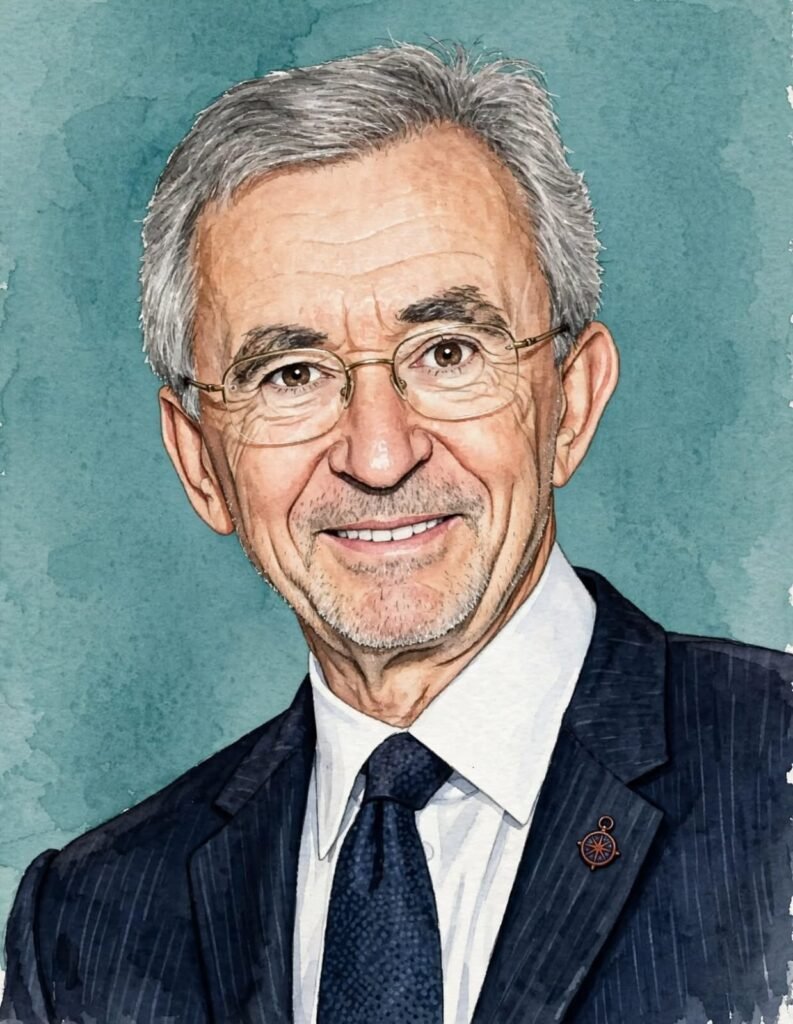
Bernard Arnault played an important role in building LVMH and turning it into a major global company. LVMH is the world’s largest luxury goods business group, with 75 brands under its ownership. Bernard Arnault is its Chairman and Chief Executive Officer.
In 2022, Forbes named Bernard Arnault the richest person in the world. In 2023, Elon Musk overtook him again after some time.
The 74-year-old Bernard Arnault is also known as the “Pope of Fashion” and, famously, as the “Wolf in Cashmere.” Bernard Arnault does not like appearing on social media or being in the public spotlight. He does not enjoy public attention and fame.
Bernard Arnault: Early Life and Business Journey
Bernard Arnault was born in 1949 in Roubaix, France. His father, Jean Arnault, owned a small civil engineering company, and his mother’s name was Marie-Josèphe. He was one of five children and grew up in a middle-class family.
Because his father owned a small engineering company, the family lived a comfortable life. As a child, Arnault was intelligent and ambitious. He was a good student and developed an interest in business and finance from an early age.
He often played shopkeeper with his siblings and was always looking for ways to save money and make a profit. He was also a talented football and tennis player.
At the age of 18, he moved to Paris, where he enrolled at the prestigious École Polytechnique and studied civil engineering. He was the first person in his family to attend university. He performed very well and graduated with honors.
While living in Paris, he visited the city’s famous fashion houses. Paris was a major center of the fashion industry, and these visits helped him develop an interest in luxury goods.
After graduating, Arnault returned home and joined his father’s construction business. He soon proved to be a valuable member of the company and was eventually appointed head of its real estate division.
He successfully helped develop his father’s business. While working there, he showed an innovative approach and convinced his father to shift the company’s focus from construction to real estate.
In 1974, the company was renamed Ferinel. In 1977, Arnault became its CEO, and in 1978, he became its Chairman.
In 1981, after François Mitterrand was elected President of France, Arnault left France and moved to the United States. Three years later, he returned to France and bought the financially troubled textile company Boussac, defeating several strong competitors.
He then began a major restructuring of the company and kept only some of its businesses, including the fashion house Christian Dior.
Christian Dior became the foundation of his luxury empire.
Bernard Arnault built his luxury business through strategic investments and acquisitions. In 1987, Louis Vuitton and Moët Hennessy merged to form LVMH. Arnault gradually increased his influence in the group and became its chairman in 1989. After taking control, he focused on acquiring and developing leading brands in fashion, spirits, watches, jewelry, and other luxury sectors. Over the following decades, LVMH expanded into a global luxury empire with more than 75 brands. His growth strategy was based on acquiring strong brands, investing in their long-term development, and maintaining their unique identities.
Bernard Arnault’s Business Growth and Mindset
Bernard Arnault’s business growth was based on several important qualities, including the ability to see opportunities, strong ambition, innovation, careful risk-taking, good negotiation skills, patience, hard work, and long-term thinking. He did not see business as something limited; instead, he looked for bigger opportunities and new ways to grow. He had a strong desire to move forward and achieve bigger goals, because great success requires both big goals and a broad vision. He was not afraid to change traditional business methods and look for new opportunities, such as moving his father’s business from construction to real estate. His success did not come quickly. It was built through hard work, patience, and long-term planning. He was willing to make big decisions, but these were not simply emotional risks; they were carefully considered business decisions. He used strong negotiation skills to build his position and continued his overall strategy even when he faced difficulties and failures. He failed in attempts involving businesses such as Gucci and Hermès, but he did not give up and continued looking for new opportunities. Another important part of his personality is that he preferred to stay away from unnecessary publicity and public attention and focused more on business results. Overall, his business mindset can be described as having big goals, finding new opportunities, working hard, staying patient, taking calculated risks, remaining consistent, and focusing on long-term growth