
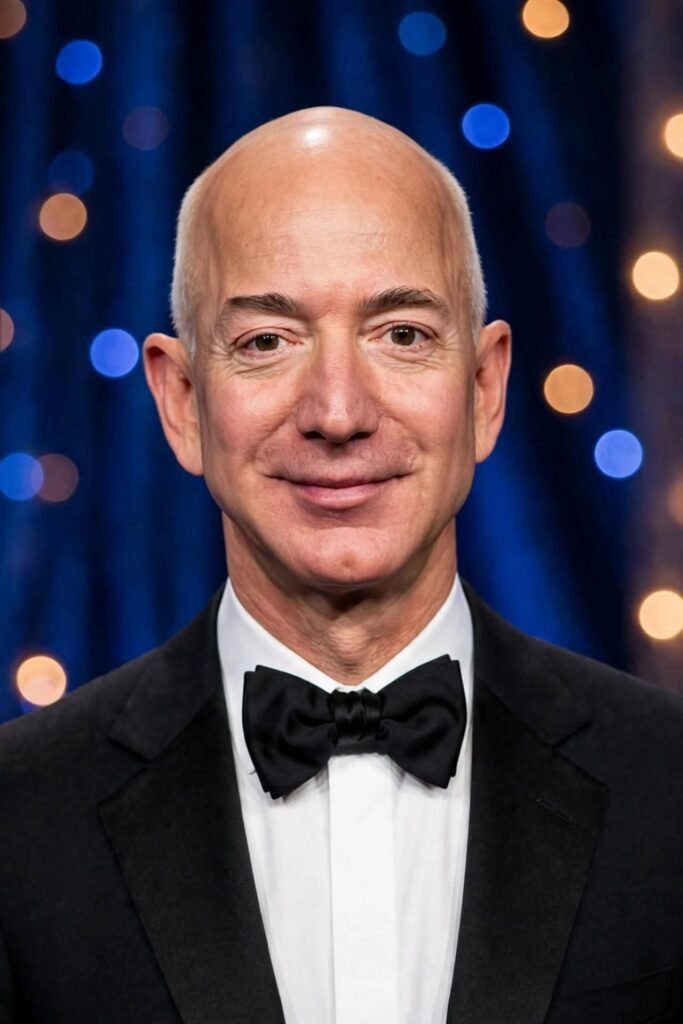
*Jeff Bezos Before Amazon
Jeff Bezos was born as Jeffrey Preston Jorgensen on January 12, 1964, in Albuquerque, New Mexico. His mother, Jacklyn Gise, was a teenager, and his biological father was Ted Jorgensen.
When Jeff was four years old, his mother married Miguel “Mike” Bezos, a Cuban immigrant. Mike adopted Jeff, and he took the Bezos family name.
Jeff was raised by his mother and stepfather. From an early age, he learned the importance of hard work, creativity, and solving problems.
He grew up in Houston, Texas, and later in Miami, Florida. As a child, he loved science and mechanics. He turned his parents’ garage into a small laboratory where he built and tested different electrical projects.
When he was a student, he once told his teacher, “The future of mankind is not on this planet.”
While studying at Miami Palmetto High School, he graduated as valedictorian and started the Dream Institute, a summer educational camp for younger students.
Bezos attended Princeton University and graduated with high honors (summa cum laude) in 1986. He earned degrees in electrical engineering and computer science.
After graduation, he turned down job offers from Intel and Bell Labs and joined a startup called Fitel.
Later, he helped launch a news-by-fax company with Halsey Minor, the founder of CNET. The business failed, but it helped him move forward in his career. He later joined D. E. Shaw & Co., where he became one of the youngest senior vice presidents.
In 1994, Bezos learned that Internet use was growing by 2,300% every year. This inspired him to create Amazon.
Although his boss advised him not to leave his job, Bezos took the risk and founded Amazon in 1994.
On April 3, 1995, Bezos started Amazon.com from a garage in Seattle as an online bookstore with a $10,000 investment.
Jeff Bezos: How Amazon Became the Foundation of His Business Empire
Jeff Bezos built his fortune around a simple idea that emerged at a time when the internet was beginning to change how people lived and did business. In 1994, while working at the hedge fund D. E. Shaw & Co., Bezos became fascinated by the rapid growth of the internet, which he understood was expanding at about 2,300% a year. He decided to act on the opportunity even though his decision meant leaving his job against the advice of his boss.
That decision led to the creation of Amazon.
Bezos started the company as an online bookstore, initially operating from a garage with about $10,000 of his own money. Amazon.com officially launched in July 1995. The business quickly expanded beyond its original expectations, selling books across all 50 U.S. states and in 45 countries.
Raising money was one of the early challenges. Bezos had initially estimated that Amazon could generate $74 million in sales by 2000, but the company exceeded that projection by a wide margin. Amazon recorded $1.64 billion in sales in 1999 alone. Bezos also raised about $1 million in seed funding from angel investors after receiving financial support from his family.
The early investors who backed Amazon took a major risk. If roughly 20 of those investors had each invested $50,000 for about a 1% stake, their combined holdings could have grown to approximately $3.5 billion over 20 years, representing a 70-fold return.
In June 1996, Amazon raised another $8 million in Series A funding from venture capital firm Kleiner Perkins. The following year, Amazon went public in May 1997. The company survived the collapse of many internet businesses during the dot-com bust and continued expanding. Its annual sales rose from just $511,000 in 1995 to more than $3 billion in 2001.
From an Online Bookstore to a Global Business
Bezos did not intend for Amazon to remain a bookstore. In 1998, the company expanded into CDs, beginning a much broader transformation. Over the following years, Amazon added an increasingly wide range of products. By 1999, its offerings included items such as concrete mixers and smoke detectors. By 2003, customers could find products ranging from electric scooters and tennis racquets to hundreds of varieties of cheese.
The company also began developing services that went far beyond online shopping.
In 2005, Amazon introduced Amazon Prime, initially charging $79 a year for free two-day shipping. That same year, it launched Mechanical Turk, an online marketplace designed to connect people with tasks that computers could not easily perform.
In March 2006, Amazon Web Services, commonly known as AWS, was launched. The service allowed businesses to rent computing power and database storage rather than building all of that infrastructure themselves. AWS later became an important part of Amazon’s business and became widely used by technology startups and other companies.
During the first six months of 2018, Amazon reported slightly more than $3 billion in operating income from AWS, which was a little higher than the operating income generated by its North American retail business.
Amazon also moved into consumer technology. Its first major successful hardware product was the Kindle, a digital book reader introduced in November 2007. The device connected Amazon’s retail business with digital publishing and gave customers another way to access books through the company.
Not every product succeeded. Amazon also entered the smartphone market with the Fire phone, but the product had only a short life. Even with such setbacks, Bezos continued expanding Amazon into new areas.
Strategic Acquisitions and New Markets
Bezos used Amazon’s growing financial strength to pursue acquisitions in several industries.
In January 2008, Amazon acquired audiobook company Audible for $300 million, only a few months after the Kindle had been introduced. In 2009, it purchased online shoe retailer Zappos for just under $1 billion in stock.
Amazon later made an even larger move into grocery retail. In August 2017, it acquired Whole Foods for $13.6 billion in cash. The company also entered online pharmacy services with its approximately $1 billion purchase of PillPack, a startup that worked with pharmacies to prepare personalized packages of prescription and over-the-counter medicines for customers’ homes.
These acquisitions reflected Bezos’s broader approach to expanding Amazon beyond its original role as an online retailer. The company moved into digital content, cloud computing, grocery delivery, consumer electronics, and healthcare-related services.
The Growth of Amazon and Bezos’s Wealth
Amazon’s growth was reflected in its stock price as well as its sales. Between January 2016 and January 2021, Amazon shares increased by about 450%. From January 2020 to January 2021 alone, the stock gained about 60%. The shares then experienced a prolonged decline beginning in 2022 and continuing into early 2023, although by 2024 the stock had recovered significantly toward its 2021 levels.
Bezos’s personal wealth rose sharply as Amazon expanded. In one period of rapid growth, his fortune increased by a record $78.5 billion in a year, helped by a 104% rise in Amazon’s stock price. During the first six months of 2018, Amazon generated more than $100 billion in net sales, an increase of 41% compared with the same period of the previous year.
Bezos had already appeared on the Forbes 400 list in 1998 as the 102nd-richest American, with a reported net worth of $1.6 billion. That came only a few years after Amazon was founded and about a year after the company went public.
By the end of 2024, Bezos retained roughly 10.8% ownership of Amazon, making the company a major source of his wealth. The company’s 2024 annual meeting announcement showed him holding more than 1 billion Amazon shares. The source material also describes Amazon as having grown from its original garage startup into a company valued at about $2.5 trillion.
Investments Beyond Amazon
Amazon is not the only source of Bezos’s wealth or business interests. He has also invested in traditional assets, technology companies, media businesses, transportation, and other ventures.
Real estate has been another part of his holdings. Bezos acquired the approximately 165,000-acre Corn Ranch in Texas as a base for Blue Origin, his aerospace company. The property also serves as a testing location for the company’s New Shepard rocket, a vertical-landing, crewed suborbital spacecraft.
Amazon itself has also accumulated significant property holdings. In 2012, the company purchased its South Lake Union headquarters buildings in Seattle for $1.5 billion. The acquisition made Amazon one of the area’s largest commercial property owners, giving the company nearly a dozen buildings, close to 2 million square feet of office space, and about 100,000 square feet of retail space.
Bezos has also invested in technology and communication companies. His investments have included Twitter, now known as X, as well as the business news organization Business Insider. In 1998, he became an early investor in Google. His original investment was reported at $250,000, and although the amount of stock he retained after Google’s 2004 public offering was not disclosed in the source material, the investment has been described as potentially worth billions.
Other companies backed by Bezos include Zocdoc and Nextdoor, both platforms built around connecting people. He also invested more than $30 million in transportation company Uber.
Another investment success was Workday, a company providing cloud-based human resources services. Shortly after Bezos made a venture capital investment in the company, Workday went public in an IPO that raised more than $684 million.
His investments have not been limited to technology. Bezos also invested in Glassybaby, a company known for producing hand-blown glass holders for votive candles.
The Washington Post and Other Ventures
In August 2013, Bezos purchased The Washington Post for $250 million. The acquisition expanded his interests into traditional media and gave him ownership of one of the best-known newspapers in the United States.
His interests have also included projects focused on long-term ideas and technology. Bezos invested in a project to build a clock inside the Sierra Diablo mountain range in Texas. Known as the 10,000-year clock project, it is designed to operate on a timescale of 10,000 years, with the clock intended to tick once each year.
Bezos also explored new ways to change how goods are delivered. In 2013, he announced plans for Amazon Prime Air, a proposed drone delivery system designed to take packages directly to customers. The first Amazon Prime Air drone deliveries began operating in limited areas in 2022, with plans for expansion.
Blue Origin and Bezos’s Space Ambition
Bezos’s interests eventually extended beyond Earth.
His aerospace company, Blue Origin, became one of the major long-term projects funded by his fortune. The source material states that Bezos has committed about $1 billion a year to the company. Blue Origin developed reusable rocket technology, and in 2016 it became one of the first commercial companies to launch a reusable rocket.
The company operates from the Texas property Bezos acquired as its base and testing location. Its New Shepard rocket was designed for vertical landing and crewed suborbital flights.
Space exploration was also connected to a childhood idea Bezos once expressed to a teacher: that humanity’s future would not remain on Earth. Years later, his growing wealth allowed him to pursue that interest through Blue Origin.
A Business Built on Expansion
Bezos’s rise was not based on Amazon remaining a successful online bookstore. The company repeatedly entered new markets, from books and CDs to consumer goods, cloud computing, digital devices, grocery delivery, pharmaceuticals, and other services.
The original idea began with the rapid expansion of the internet in 1994. Amazon started with a small garage operation and a relatively modest personal investment. Over time, Bezos used the company’s growing sales, technology infrastructure, and cash flow to expand into new industries and acquire established businesses.
His ownership of Amazon remains a central part of his wealth. At the same time, investments in technology, media, real estate, transportation, and aerospace have created a broader financial and business portfolio.
From an online bookstore founded in the mid-1990s, Amazon developed into a company with interests spanning retail, cloud computing, technology, entertainment, logistics, groceries, and healthcare-related services. Bezos’s continuing investments, particularly in Blue Origin, show how his business interests have extended well beyond the company with which he first became known.
The Mindset and Decisions Behind Jeff Bezos’s Success
Jeff Bezos’s journey to success was shaped by a willingness to take risks, think far ahead, and keep moving after setbacks. His story shows a pattern of looking for major changes, acting on opportunities early, and building for the long term rather than focusing only on immediate results.
Before Amazon, Bezos had already taken an unusual path. He helped launch a news-by-fax service with Halsey Minor, the founder of CNET, but the business failed. He later became the youngest senior vice president at the hedge fund D. E. Shaw. It was there, in 1994, that he became fascinated by the rapid growth of the Internet. He learned that Internet use was increasing by about 2,300% a year, and this gave him the idea of creating an online business.
Bezos eventually left D. E. Shaw and started Amazon in 1994, despite his boss advising him against the decision. This became one of the most important decisions of his career. What began as a small startup grew into one of the world’s most successful companies. Amazon went public in May 1997 and survived the dot-com bust, while many other startups of that period failed.
A major part of Bezos’s approach was his willingness to accept uncertainty. He did not treat failure as a reason to stop experimenting. Instead, his career shows a repeated pattern of entering new areas and trying to build something for the long term. Amazon expanded far beyond its original online bookselling business, entering many different areas, including cloud computing.
Bezos also placed strong value on thinking about the future. His belief in long-term thinking became part of the way he approached both business and innovation. He even invested in a large clock designed to keep time for thousands of years, explaining that today’s global problems require “long-term thinking.” His interest in the future was also connected to his childhood dream of becoming a space entrepreneur, which he later pursued through Blue Origin.
His own words provide a clear picture of how he viewed success and change. In an interview published in Vanity Fair, Bezos said, “You need to be nimble and robust so you need to be able to take a punch and you also need to be quick and innovative and do new things at a higher speed, that’s the best defense against the future.”
This idea can be seen throughout his career. He combined the ability to withstand setbacks with a willingness to change and try new things. He also believed that businesses should not become too comfortable with their existing success. Instead, they should continue behaving as if they are still at the beginning.
This thinking became known inside Amazon as the “Day One” philosophy. Bezos repeatedly reminded the company of this idea in his annual letters to shareholders by including the original 1997 shareholder letter. At that time, Amazon had about 1.5 million customers. In that original letter, Bezos wrote that online bookselling and online commerce in general could become a very large market. He ended by saying, “We feel good about what we’ve done, and even more excited about what we want to do.”
The same approach helped shape Bezos’s response to setbacks and changes. Amazon’s stock experienced a long decline from 2022 into early 2023, although it later moved closer to its 2021 levels in 2024. Despite such difficulties and changes in his own position, Bezos continued to pursue new opportunities rather than relying only on what he had already achieved.
His success also brought enormous wealth. Bezos became the richest American on the Forbes 400 list for the first time, breaking a position that had long been associated with Microsoft cofounder Bill Gates. Although he later lost the title of the world’s richest person, he remained among the wealthiest people in the world. Much of his wealth has been connected to his ownership of Amazon, where he retained roughly 10.8% ownership at the end of 2024.
Bezos has described his approach to success through several simple ideas: take bold bets, recognize change, and recover from setbacks. He has also emphasized the need to keep moving toward the future rather than resisting it. As he put it, “You have to always be leaning into the future. If you’re leaning away from the future, the future is gonna win, every time.”
Taken together, Bezos’s journey shows a combination of risk-taking, long-term thinking, resilience, constant innovation, and a refusal to become satisfied with past achievements. From leaving a successful career to start Amazon to expanding into cloud computing and spaceflight, his decisions repeatedly reflected his willingness to enter uncertain territory. For Bezos, even after achieving historic success, the work was still only “day one.”